A Walking Confession, A Walking Book

Neal Pollard

All people in the world are watching our words and deeds.  Jesus teaches, “Let your light so shine before men, that they may see your good works, and glorify your Father which is in heaven” (Matt. 5:16).  Jesus is calling for a “walking confession,” a life which is an open book.

The Christian’s life is a manual, revealing what a Christian talks and acts like (Matt. 5:16).  It is a cookbook, showing the necessary ingredients which combine for a rich, full life (2 Pet. 1:5-11).  It is a code book, the reading of which will safely point others to the place of God’s acceptance (1 Tim. 4:12; Rom. 12:1-2).  It is a thriller in that it is bound by all the spiritual blessings that are to be had (Eph. 1:3).  It is a medical book in that it reveals the evidences of the Great Physician (Mark 2:17; Jer. 8:22).  It is a suspense because the best is yet to be for the Christian as “it does not yet appear what we shall be…” (1 John 3:2).  The Christian is read very carefully by “all men” (2 Cor. 3:2).  As our lives are read, what notes do the readers place in the margin?  If they were to label the book of our lives, what would they say?  “Couldn’t put it down!” (Titus 2:8)?  “This book contains error” (1 John 4:6)?  “Easy to follow” (1 Tim. 2:2)?  “Discard” (Rev. 3:14-19)?  “Pages missing” (2 Pet. 1:9)?

Peter found it very easy to confess the Lord before the other disciples.  He vowed, “Lord, I am ready to go with thee, both into prison, and to death” (Luke 22:33).  Before the next morning’s light hit his face, Peter had denied his Lord three times before men (Luke 22:54ff).  The camaraderie of other believers put Peter to no test, but out there in the world Peter failed the test.  Perhaps arrogance contributed to his denial.  Obviously, fear was involved.  The prospect of ostracism and rejection led to his cowardice.

If an apostle would stumble at confessing Christ before men, what about you and I?  Separated from the pull and pressures of the world when in the assemblies, we have no difficulty preaching (or hearing), singing, and praying our devout faith in Jesus.  But, when the support group disbands to address life’s daily affairs and the group becomes individuals scattered into different jobs, neighborhoods, schools, and homes, do our lives confess Him?  Do we tell others by our actions that Christ is our Lord?  Do we show them that He is first (Matt. 6:33)?  Out there (in the world) is where Jesus’ conditional statement in Matthew 10:32-33 applies.  If we “stick up” for Christ in the daily tests, then He will reward our triumph over temptation.  Out there is where Christ needs others to see our confession and read our lives.

When Lightning Strikes Seven Times?


Neal Pollard

Did you know that on this day in history, 1972, a young man was struck by lightning in Waldport, Oregon?  What makes it worse was that he was carrying 35 sticks of dynamite at the moment!  Living here in close proximity to the Rocky Mountains, we are all too aware of the danger of being struck by lightning at high altitude.

But, can you imagine being Roy Sullivan? I was interested to learn about this park ranger from Shenandoah National Park in Virginia.  He was struck by lightning seven times between 1942 and 1977, surviving them all.  In a book about the phenomenon of lightning, Out of the Blue, John Friedman talks about Sullivan’s traumatic experiences.  In order, he was struck in a lookout tower, while driving on a mountain road, walking in his yard, standing in a ranger station, getting out of his truck, checking a campsite near Skyline Drive, and fishing in a freshwater pool. He caught fire during one strike, singed his eyebrows, suffered chest and stomach burns, injured an ankle, and seared his left shoulder through these frightening experiences, but he never was seriously injured.  Was he “lucky”?  Apparently, he did not think so.  No one knows why he did it for sure, whether being rejected by a woman he loved or dreading future lightning strikes, but the big, burly lightning rod of a man died of a self-inflicted gunshot wound in 1983 at the age of 71 (Friedman, 3-5).

Have you ever felt like you were receiving more than your fair share of adverse, difficult circumstances?  Like you were going from being hit by one bad situation after another?  What do you do when bad things keep happening to you?

Interestingly, Sullivan did not view this as God’s punishment.  He astutely told a TV audience that if God had wanted to do him in, He could have easily done so with only one strike!  What we should not do is look at suffering and trials as something with which God is trying to punish us.  All of us need character refinement and discipline (Heb. 12:5ff), but dare we say that those we see suffering need more refining.  Job and his friends, as well as people in Jesus’ day (John 9:1f), automatically saw suffering as divine punishment.  But, bad things happen to good people.

A series of unfortunate events may befall us at times in life.  But, we are not alone.  Others are hurting. And, we can grow from these pains.  Most of all, remember that “God is faithful, who will not allow you to be tempted beyond what you are able, but with the temptation will provide the way of escape, so that you will be able to endure it” (1 Cor. 10:13).

Do Not Love The World

Neal Pollard

“World” is one of those words with multiple meanings.  It can refer to the earth, to all the people on that earth, or a philosophy or system of thought.  When John says, “Do not love the world or the things in the world” (1 John 2:15), he is referring to the last of those three ideas.  The behavior and philosophy of the world follows that of the prince of this world (Eph. 2:2), characterized by trespasses and sins, fleshly lusts, desires of the flesh and mind, and the like (Eph. 2:1-3).  That is what we are not to love.

Paul warns against approving of those who do worldly things in Romans 1:32.  Those things include all unrighteousness, sexual immorality, wickedness…evil-mindedness… inventors of evil things” and more, including homosexuality (Rom. 1:26-31).  The Bible must be consulted to help determine what of the things in culture fit into the category of things like we read in Ephesians 2, Romans 1, Galatians 5, Colossians 3, 2 Timothy 3, and the like.  Some things, in and of themselves, are neutral.  Other things, inherently, are sinful and, thus, “worldly.”

Christians set on defending, praising, promoting, or excusing things that are sexually suggestive, immodest, debauched, perverse, and depraved find themselves militating and working against the very Christ they profess to follow.  To praise sin is to love the world.  To defend immorality or excuse those who do it is to love the world.  To see things through worldly eyes, with worldly values, is to love the world.  Scripture is unequivocal about the matter.  John continues, “If anyone loves the world, the love of the Father is not in him. For all that is in the world–the lust of the flesh, the lust of the eyes, and the pride of life–is not of the Father but is of the world. And the world is passing away, and the lust of it; but he who does the will of God abides forever” (1 John 2:15b-17).  Before we choose our heroes, role models, habits, hobbies, diversions, and desires, we do well to review John’s God-breathed words and make sure we are not in love with the world!

I LOVE Political Commercials!

Neal Pollard

No, I don’t!  I hate them.  But, I imagine that statement both caught your attention and led you to do an armchair assessment of my sanity (or lack thereof).  There are so many reasons not to love them.  First is content.  Every candidate makes vague, pie-in-the-sky promises that are hard to measure and quantify.  Second is tone.  The mud content of most is thick and dirty, and their razor-sharp rhetoric about the other guy pushes the mental pain threshold of the most patient listener.  Third is repetition.  Certainly, the same commercial will air repeatedly, but the proliferation of such ads in general is so great that it seems to be every other commercial.

I love gospel preaching!  That is the truth.  I love to hear the old, old story faithfully told through the medium of different men with different styles, personalities, and perspectives.  Short or tall, young or old, experienced or less so, well-educated or less so, I glean at least something from most lessons I hear.  Content, tone, and balance can   make or break the message, though the message rather than the man should be the focus.  Truth should be told, and it should be told in love!  It should never be that we should turn off the listener by changing the message or using methods that are unkind and even unscrupulous.

The relief is that political ad season is relatively short-lived (it only seems otherwise).  The joy is that we get to hear God’s Word proclaimed whenever we assemble to worship God.  The more we fill those lessons with Bible, properly parsed and presented, the more proper feeding and nourishing will occur among those who properly listen.  Perhaps thanks to the Jule Miller Filmstrips, one of my favorite songs says, “Tell me the story of Jesus, write on my heart every word.  Tell me the story most precious, sweetest that ever was heard.” Amen!

(P.S.–That’s a big reason why I am so excited about our lectureship this week!  What a theme and what great speakers to thrill our souls with the matchless story!)

BE THANKFUL IF YOUR ELDERS…

Neal Pollard

  • Are willing to lead you to do what’s right and biblical, even if unpopular and uncomfortable.
  • Want the Bible classrooms and pulpit to stay on biblical center, veering neither to the left or right (cf. Josh. 1:7)–regardless of what the churches down the street do.
  • Are kind and friendly, even if at times without polish or oratorical articulation.
  • Expect the best from you, but ask you to do nothing they themselves are not doing (1 Pet. 5:3).
  • Are among you rather than above you or aloof from you (1 Pet. 5:1).
  • Obviously love you, even if they occasionally have to correct or admonish you (1 Th. 5:12).
  • Prioritize the work with spiritual objectives taking precedence over material objectives and with evangelistic goals over an internal focus.
  • Ask the church to do for others rather than try to cater to our whims and desires (Heb. 13:17).
  • Are impartial rather than prejudiced or cliquish.
  • Are driven by “what does the Bible say” rather than “what do the people want?” (Acts 20:28).
  • Stand behind and commend even difficult lessons that move us to obey God.
  • Show commitment to their task through time, effort, and zeal rather than being those who go through the motions (Heb. 13:7).

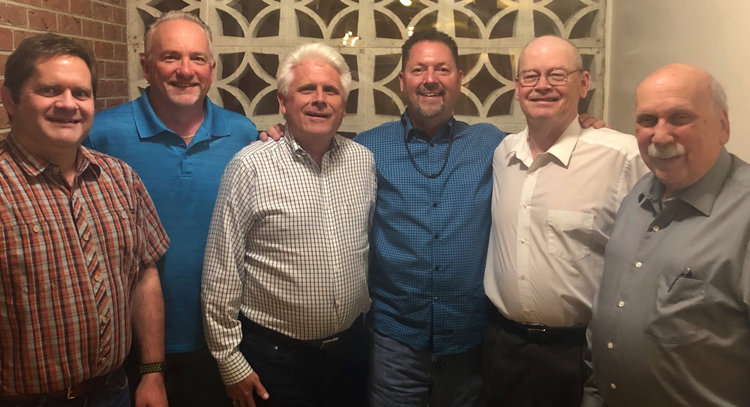
For these and many more reasons, I am thankful for the Bear Valley eldership!  They are numbered among the “all” who sin and fall short of God’s glory (Rom. 3:23).  They each have strengths and weaknesses.  Yet, these are men so driven by God’s will and God’s Word, and I am thankful to preach and attend under the oversight and authority of such men.  My heart aches for those who are not afforded such a pleasure, and it thrills for those who do.  Have you thanked God for your elders today?  Have you thanked your elders (1 Th. 5:13)?  They do not serve for recognition or accolades, but they just as surely will not rebuff your appreciation!  May we be grateful sheep!

bvelders
L-R: Thom Vaught, Scott Balbin, Mike Ripperton, Dean Murphy, Donnie Bates, Dave Chamberlin (the shepherds of the Bear Valley church of Christ, Denver, CO) Photo: May, 2019


“We Hate America!”

Not to frustrate the patriotic, but this is not a piece about the United States, politics, or cultural commentary.  The caption is from the headline on the top fold of today’s USA Today in a story about the 9/11 attack on the American Embassy in Benghazi, Libya, that killed four Americans.  It is likely the work of al Qaida and Muslim extremists in the ever-volatile middle east, but it speaks to the tenuous, unpredictable relationship of the “west” with the “east.”  Libya receives hundreds of millions of dollars in aid from the U.S., was helped by this nation to topple the Khadafi-led regime that led to the new, fledgling government, and America led the efforts in the United Nations to repeal a 40-year-old resolution to allow the new government to receive assets.  As Secretary of State Clinton posed it, “How could this happen in a country we helped liberate, in a city we helped save from destruction?” (Lynch, Dorell, and Jackson, USA Today, A-1, 9/13/12).

Lives were lost and upheaval seems inevitable now!  More American lives are likely at stake, in Egypt and who knows where else?  How could they “turn” on their “benefactors”?

As a wealthier, more stable, and “more civilized” nation, we may see ourselves as superior to our attackers.  But, the current crisis is but a mild illustration of the way man often treats God.  He created us in His image, sent His only begotten Son to die in our place, shows through His Word, His providence, and His sustaining blessings that He loves us, wants us to be His children, wants us to live an abundant life, and wants us to be with Him in heaven forever.  But, the vast majority of mankind shows disdain for and disobedience toward God!  Some say the words, but others show God contempt through ungodliness and self-centered disregard for Him.  This is not only even more audacious, but it is more costly.

Jesus says not only to call Him Lord, but to show it (Lk. 6:46)!  Choosing anything above God is to tell Him we hate Him (cf. Lk. 16:13).  Loving less is not an option!

THE PURE AGONY OF PRACTICAL AGNOSTICISM

Neal Pollard

Philosophical types revel in “not knowing.”  They like to challenge and undermine the faith of believers, asserting that we cannot really know anything.  It is a sort of insanity, really.  Can you imagine going through life confident only of the belief that nobody can truly know anything?  Yet, that is where a great many stand, including some who would profess to be Christians.  They say, “Objective truth is unknowable,” “God is unknowable,” and only fools and simpletons say otherwise.

Poor John.  He missed that memo.  It was not because he lived in the time before philosophy was born.  He wrote that masterful, Divinely-inspired first epistle bearing his name at the front end of a movement that would come to be known as “gnosticism.”  While gnostics would consider themselves an elite spiritual force who alone had special knowledge, they and their predecessors to whom John writes enjoyed trying to knock the mental legs from beneath those who were trying to hold onto assurance.  The more things change, the more they stay the same.

How could John say things like, “Now by this we know that we know Him, if we keep His commandments” (2:3). “…We know that we are in Him” (2:5).  “…You know that He is righteous” (2:29).  “…You know that He was manifested to take away our sins” (3:5). “By this we know love, because He laid down His life for us” (3:16).  “We know that we are of the truth” (3:19, a particularly galling statement to some).  “By this we know the spirit of truth and the spirit of error” (4:6).  “You may know that you have eternal life” (5:13).  About 20 more times in this short letter, John asserts something that we know or that can be known.  Maddeningly simple, but stubbornly confident!  Why would John try to move away from the esoteric and enigmatic?  Why would he boost his readers’ confidence in what they could and should know?

Try living life without that assurance.  Many do.  Not coincidentally, many are unequivocally miserable!

MOST MISERABLE


Neal Pollard

Do you remember when Paul said, “If in this life only we have hope in Christ, we are of all men most miserable?” (1 Cor. 15:19). The context is the reality of the resurrection. Consider the misery, if not for the resurrection.

  • No victory over Satan. Satan is still our only choice of master, if there is no resurrection (Heb. 2:14ff). His power exceeded God’s (cf. Psa. 16:10; Gen. 3:15).
  • No hope in death. The chronically ill, impoverished, deeply betrayed, persecuted, martyred, ridiculed and sacrificial Christians who faithfully endured are hopeless. Death’s stinger remains embedded and grave’s victory is secured (cf. 1 Cor. 15:57). Without the resurrection, we drop in the dirt in no way different from the wicked.
  • No reunion with those who die in Christ. David’s hope was deluded concerning his dead son (2 Sam. 12:23). Unborn babies, infants, and innocent children, who die at those stages, are not lost (Ezek. 18:20; Isa. 59:2). We are separated by sin (Rom. 6:23; 1 Jn. 1:8-10). Without the resurrection, there is absolutely no prospect of seeing them again.
  • No incentive to live righteously. What keeps us from being anarchistic, animalistic, and anthropocentric, if we have no hope in the ressurection? We can do whatever is in our power. The fact of the resurrection controls and affects our conduct (cf. 2 Cor. 5:14).
  • No reason to serve God. If there is no hope or chance of heaven, what’s the use? Why do anything “in His name” (cf. Mk. 9:41)? Why use any opportunities to do good to anyone (cf. Gal. 6:10)? Why be found sacrificing self (Rom. 12:1)? Why help others (Matt. 25:35-36)? Why faithfully assemble (Heb. 10:25)? Why put on the Christian graces (2 Pet. 1:5-7) or bear the fruit of the Spirit (Gal. 5:22-24)? Why shine a light or spread any salt (Matt. 5:13-16)? Offering service to God, without the resurrection, will never be acknowledged or rewarded!

Ah, “But now is Christ risen from the dead…” (1 Cor. 15:20)! By such, He gives us assurance (Acts 17:31). Accepting the resurrection is a test of faith (Rom. 10:10), but I plead with you to pass that test! Believe in the resurrection of Christ. Otherwise, you will be most miserable living the Christian life!

“The Spirit Is Leading Us To ___________”


Neal Pollard

When I was preaching in Virginia, I received a call from a concerned brother in another state.  He related to me that the congregation where he was attending was trying to push for women to serve in the church’s leadership roles.  He explained that the preacher’s and leadership’s defense and rationale was that the Holy Spirit was moving among them and leading them to this conclusion.

Have you ever heard a person or congregation seek to promote or defend a practice by claiming this kind of Spirit-guidance?  On the surface, it may seem powerful or compelling.  After all, if God is leading one to do something who is to oppose it?

The interesting (and important) thing is that the Spirit has already led us to truth on the matters pertaining to life and godliness (cf. 2 Pet. 1:3).  The Spirit inspired His Bible writers to reveal all truth (cf. John 14:26; 16:13).  Other passages, like 1 Corinthians 2:13 and 2 Peter 1:21, show God’s deliberate process of revealing His truth through inspired men in the time of the Bible.  You will also notice that God confirmed the word of His spokesmen through miracles, wonders, and signs (Acts 2:22,43; 4:30; 5:12; 6:8; Rom. 15:19; Heb. 2:4).

When someone contends today that the Spirit is moving them or the congregation to do “X,” a couple of puzzling conundrums must be solved.  First, if “X” conflicts with God’s revealed truth in Scripture, why is the Spirit calling for it and why should this calling trump God’s original will on the matter?  Second, what miracle, wonder or sign will be done to confirm the validity of it?  Third, what if someone else says, “But the Spirit is leading me to tell you that’s not correct?”

The Spirit is leading us and speaking to us today.  He does so powerfully, through the Word He moved men to write (cf. Heb. 4:12).  This sword of the Spirit (Eph. 6:17) is ample to guide us to do all the will of God!

Giving Our Kids “Peaceful Fruit”

Neal Pollard

Paul’s inspired illustration about the church is so rich and powerful that Ephesians 5:22-33 is a text that has been used to preach many a sermon about marriage.  What the writer of Hebrews does with Divine discipline is just as compelling.  In urging the Christians to remain faithful despite persecution (Heb. 12:4), he tells them they had forgotten the biblical exhortation about God’s discipline of His children.  The writer goes on to use the illustration of earthly parents disciplining their children.

You have seen the fruit of undisciplined children.  It is both rotten and smelly, whether it’s a toddler’s tantrum, an adolescent’s attitude, or a teenager’s “‘tude.”  Seeing undisciplined children is enough to appreciate the wisdom of statements like “a child left to himself brings shame to his mother” (Prov. 29:15).  It is unattractive in youth, but destructive in adulthood.

In Hebrews 12, the writer uses the word “discipline” eight times in seven verses (plus one time inserted by translators in verse 10).  That makes it vital to the context of this paragraph.  Discipline proves love to children (6), provides legitimacy to children (7-8), produces loyalty from children (9), and perfects pure lives in children (10) though it prompts lamentations in children when it is administered (11).  Yet, in showing how He interacts with His faithful ones, God reminds us how He wants us to parent our children.  He wants us to teach them discipline.

How do we do that?  The writer uses words like “reprove” (5) and “scourges” (6) “as seemed best to them” (10) in a way that “for the moment” is “sorrowful” for the child (11).  If you ever had a parent who failed to “spare the rod” of correction, you can relate.  We do well to remember that “foolishness is bound up in the heart of a child; The rod of discipline will remove it far from him” (Prov. 22:15).

“Experts” tell us that all corporal punishment will warp and frustrate the recipients.  Violent, uncontrolled hitting may well do so, but not loving, measured spankings meant to teach right from wrong.  Likewise, having rules and restrictions, consistently enforced, gives a child structure and boundaries.  Children actually want to know their limits, and they (and God) expect parents to spell them out to them.  Look down the road at the consequences of that kind of parenting.  What will your children reap?  The inspired writer calls it “the peaceful fruit of righteousness” (11).  There are few gifts as precious and meaningful as that!

Liberty On Labor Day

Neal Pollard

In 1838, September 3 was also on a Monday.  It was many years before the first Monday of September was designated as the “Labor Day” holiday, but on that day a monumental effort occurred.  On September 3, 1838, Frederick Douglass escaped slavery disguised as a sailor.  Later, he would write a book about his life in slavery (www.historynet.com).

Douglass had to work for his freedom, to rely on his cunning and ability.  He left the fields of Maryland’s Eastern Shore at the age of 18 to caulk ships, earning a wage for his master.  He borrowed a friend and fellow passenger’s “sailor’s protection” papers, which, if it had been examined closely, would have described a man much darker than himself.  To his favor, the conductor, who had been harsh and impatient with the other black passengers in the car, spoke pleasantly to him and the paper Douglass showed looked extremely official.  He spent all of September 3, 1838, hoping and praying that “slave catchers” in Maryland or Delaware would not snare him, but he survived the day and ultimately arrived in New York City.  He had to continue running, as slave-catchers resided there, too. Not long after, having arrived in New Bedford, Massachusetts, he hired himself out at the wharves. En route to search out this work, he asked if he could help put up a large pile of coal in front of a preacher’s house.  The lady of the house gave him two silver half-dollars for the work, the first money he earned as a free man (www.eyewitnesstohistory.com).

You and I, outside of Christ, are described as “slaves of sin” (Rom. 6:6,16-18,20).  Yet, we could not obtain our freedom through our cunning, wit, or abilities.  Instead, we were totally dependent upon God’s grace to emancipate us.  That does not mean that we were saved without obedience (Rom. 6:17), but it does mean that all the works and acts of obedience would be useless without God’s amazing grace (Rom. 6:14-15).  We need freedom as desperately as any slave who has ever lived, but the only way to get it is through Christ (Rom. 6:8-11).  This includes baptism (Rom. 6:3-4).

Thank God for giving us our freedom, which nothing and no one can revoke.  It was His labor, at Calvary, that brings us from sin to safety.

A Factious Man

Neal Pollard

Titus had a challenging “local work.”  He had to preach and minister on Crete, renowned for its “many rebellious men, empty talkers and deceivers” (1:10) in a culture renowned for its “liars, evil beasts, lazy gluttons” (1:12).  They paid “attention to Jewish myths and commandments of men” and turned “away from the truth” (1:14).  Their deeds denied Him, they were detestable, disobedient, and  derelict (1:16).

What do you say to a guy who has such a lot in life?  Besides expressing sympathy to him, how can you help a man in such conditions?  You will notice Paul did not tell him to move on to a new work.  He guided Titus in how to appoint the right kind of leaders (1:5-11), how to equip the right kind of members (2:1-10), how to focus on the right things (like grace, godliness, hope, sanctification, the second coming, etc., 2:11-15), and how to restore and maintain the right focus (3:1-15).

Among the troubling and difficult personalities about which Paul writes to warn Titus, there is the “factious man.”  Paul has strong, stern words of warning about him.  When we explore Paul’s words about him in Titus 3:9-11, we come to appreciate what our relationship with such a man ought to be.

Who Is The Factious Man?  Given the context, he must be the man described in verse nine.  He is a man embroiled in “foolish controversies,” “genealogies,” and “unprofitable and worthless disputes.”  The literal meaning of “factious” here is “heretical.”  He is a heretic, and he is such because of foolish controversies and worthless disputes.  What are those?  Those are matters a man will not give up fighting about but which cannot be proven to be right or wrong.  He may think them right or wrong, but he lacks scriptural support.

What Do You Do With Him?  To me, this is the most startling response.  Paul says, “Reject him.”  Literally, you dismiss him.  Why?  Because he has proven himself to be an argument-monger.  At some point, engaging with such a person is counter-intuitive and counter-productive.

When Do You Do It?  Paul lays out a specific plan of action, “after a first and second warning.”  Notice that even factious men deserve our patience and forbearance.  But, that is not to be indefinite or limitless.  Paul’s patience had its limits (cf. Gal. 2:5).  Did you know even God’s patience can be exhausted (cf. 1 Pet. 3:20)?  There comes a point when one’s efforts with a person is likened to “pearls before swine” (Mt. 7:6).

Why Do You Do It?  You do it because of knowledge.  Paul says, “Knowing that such a man is perverted and is sinning, being self-condemned” (11).  Such a man will not listen or accept admonition.  The inspired analysis of such a man is frighteningly judgmental.  With three terms, Paul concludes such a man to be lost!

The man here was hung up about the Law of Moses, but certainly such a man (or woman) can exist today.  Scripture is timeless and boundless.  Anything without rational, scriptural support that becomes one’s hobby horse and becomes divisive must be avoided.  We are to reject it.  The factious one must cease or continue at his or her own peril.

THE DIFFERENCE BETWEEN “CHANGE OF HEART” AND “REMISSION”

Neal Pollard

In 1914, Firm Foundation published a book of sermons E.M. Borden preached in Neosho, Missouri.  At the end of the book is a section of extracts, including one entitled “Change of Heart and Remission.”  In this short article, Borden writes, “One very common occurrence in this age of the world is for people to mistake a change of heart for the remission of sins” (307).  Later in the article, he adds, “There is a feeling that comes with the change of heart, which is the result of making up the mind to quit the wicked habits.  Too many times that is taken for salvation” (ibid.).  Borden’s correct conclusion is that change of heart happens on earth, but remission of sins takes place in heaven in the mind of God.

No doubt, there are many today who come to church services and worship with us.  They are exposed to teaching that effects their heart and causes them to want to live better.  That change in how they view life and the world, that appreciation for Bible teaching, and the other good things they feel and experience are necessary things.  However, a changed outlook, mentality, or worldview, alone, will not change one’s eternal destination.  However, the right state of heart and thinking will surely lead one to do what God says to do in order to receive His forgiveness.

When does remission (or forgiveness) take place?  All we can do is trust scripture for the answer to this.  When people 2000 years ago first asked the question, “What shall we do?”, they were told by Peter, “Repent, and let every one of you be baptized in the name of Jesus Christ for the remission of sins; and you shall receive the gift of the Holy Spirit” (Acts 2:38).  They had to repent, a change of heart leading to a change of life, and be baptized, immersed, in order for God to forgive them.  Mankind tries to complicate matters, but it is truly that simple.

“Thus Saith The Lord”

Neal Pollard

In a 1960 lectureship at David Lipscomb College, Rex Turner, Sr., in contrasting matters of faith and opinion, summarized with a few observations.  In part, he warned, “If the church is to continue to make a clarion plea for undenominational Christianity, it must keep its lines of communication open to the people of the sectarian world while strictly adhering to New Testament teaching…There is the very grave danger that the church, in order to keep the lines of communication open, will treat matters of faith as if they were matters of opinion.”  He then said, “There is the very imminent danger, equally as great, that the church will treat matters of opinion as if they were matters of faith and thereby sectarianize the church and divide it into a number of fragments” (Sermons and Addresses on the Fundamentals of the Faith, 75).

In his inimitable way, brother Turner was saying that we need to stay with a “thus saith the Lord” for all we say and do.  We must stand only and always on the foundation of Scripture as our authority (the King James Version uses the phrase, “thus saith the Lord,” 413 times, and the idea behind it is that there is an eternal, material difference between a “thus saith the Lord” and a “thus saith anyone else”). We rightly decry denominational teaching that has another foundation, whether regarding the plan of salvation, worship, church leadership, and the like.  What are some ways in which we may drift in the same direction as the people of God?

  • Thus saith my church.
  • Thus saith my preacher.
  • Thus saith my feelings.
  • Thus saith “Brother A.”
  • Thus saith “School A.”
  • Thus saith my family.
  • Thus saith my conscience.
  • Thus saith “Scholar A” or “Theologian A.”
  • Thus saith the majority.
  • Thus saith the culture.

We could certainly continue to expand the list, but this exemplifies the possibility of our blindly following some man, group, or institution without sufficient regard for whether or not the message is built upon a proper examination, exegesis, and expounding of the sacred text.  Whether it regards leaning to the left or the right of biblical center, we must be careful to check the ground beneath our feet.  There is no other foundation that can be rightly laid (1 Cor. 3:11).  All other ground is sinking sand (Mat. 7:24ff).  When we build otherwise, we breed division (1 Cor. 1:10).  Let us stay with a “thus saith the Lord!”

Slow Down!

Notice woman and child in right of photo

Neal Pollard

One of the classic episodes of the Andy Griffith Show is entitled, “Man in a Hurry.”  In it, a fast-paced business man learns the value of slowing down and enjoying life.  It cut against the grain of his crotchety, need-it-now gruffness, but he learned the value of taking life slower.  As a woman and her four-year-old son recently learned, when dealing with the Boston subway system, a failure to slow down can be deadly.  Video surveillance shows her leading the boy by the hand right past the platform and down onto the track below, just as a speeding train approached.  The fast, courageous thinking of commuters-turned-rescuers kept this from having a tragic ending.  Instead of talking about her and her son as fatalities, the woman lived to talk about how blessed and grateful she was.  Hopefully she learned to slow down and pay attention.

Haste makes waste, they say.  Hurrying can not only lead to mistakes, it can get one in much trouble.  Some things deserve time for deliberation.  Nothing deserves more careful contemplation than matters of eternal implication.  When it comes to how we will live life or where we will spend eternity, we must be cautious and thoughtful.  Yet, the majority are rushing headlong throughout life, oblivious to the danger.  Isaiah, for one, says, in essence, “Slow down and think!”  In exact words, he writes, “Come now, let us reason together…” (Isa. 1:18).  Therein, he makes an appeal to consider a salvation issue.

Our eternal destiny is worth the most careful consideration.  In Luke 14, Jesus preaches careful contemplation.   This is not the paralyzing, fearful hesitation that prevents one from doing what is right, but it is the precise process of self-examination urged by Paul (2 Cor. 13:5).  If you are not thinking “long term,” pondering your relationship with God, you need to slow down.

A HEZEKIAH HOME

PTP 2012 (Monday, 8/20)

Neal Pollard

The righteous king, Hezekiah, was in trouble.  He was “sick and near death” (2 Kings 20:1).  Isaiah tells him to “set” his “house in order” because he was going to die.  What could Hezekiah say?  What would you have said?

Hezekiah appealed to his home in 2 Kings 20:3.  He mentions three qualities of it.  In his house, Hezekiah walked before the Lord in truth.  That suggests that he allowed God’s word to be the standard in his home, whatever the issue.  In his house, Hezekiah had a loyal heart.  Nothing more specific is said in this regard, so this could mean loyalty in any of his relationships.  Certainly, in context, it seems that Hezekiah included in that loyalty to God.  In his house, Hezekiah did what was good in God’s sight.  His morality, judgment, and leadership were aligned with Heavenly sight.

You may remember that, upon hearing this, God grants Hezekiah fifteen more years (2 Kings 20:6).  Unfortunately, he seems to have made mistakes that negatively impacted his home in that intervening period of time.  He allowed the king of Babylon to see the treasures of his house (2 Kings 20:12ff).  He also was too short-sighted to care that this decision would greatly harm his descendents (2 Kings 20:17-18), but all he got from that was superficial comfort in knowing there would be “peace and truth at least in” his days (2 Kings 20:19).

What a reminder that we can never ease up in our homes.  Those in our homes need us doing our part to keep the home like Hezekiah kept his up until the sickness that brought Isaiah to his door.  This is an ideal home.  Someone wrote,

An ideal home cannot be built with compass, rule or square

An ideal home cannot exist without our Jesus there.

An ideal home, where Jesus reigns and all on Him depend,

Alone can save our nation, doomed, from her untimely end.

A “Strike Of Capital”

Neal Pollard

In the July/August 2012 issue of Imprimis, put out by Hillsdale College, economist and author John Steele Gordon shared five “Economic Lessons from American History.”  It is a fascinating read, but this is not a review of it.  Near the end of the article, Gordon makes a point about what financial markets call a “strike of capital.”  In stressing that the stock market hates uncertainty (what financial policies and decisions government will make), corporations engage in a “strike of capital.”  Companies have plenty of money and are making a profit, but they are unwilling to invest it until they have a clearer picture about taxes, government control, and the like.  It makes perfect sense, though in the process it can impact prices, job availability, growth, and any number of related factors (Vol. 41, Nos. 7/8, 7).

While in economics this can be a prudent thing to do, it is never what God wants us to do spiritually.  What is the church’s capital?  Certainly, it is everything God gives in spiritual and material terms (cf. Eph. 1:3; Js. 1:17), but it inevitably includes the people who make up the church.  So, what is the Christian’s capital?  Essentially, it is his or her time, interest, money, ability, and anything else over which God has made him or her a steward.  Since God’s government and plan is always perfect, none of us ever has a right or reason to engage in a “strike of capital.”  We are nothing and can do nothing without Him, who gives us everything that we have in terms of our personal “capital.”  When we consider that we are to use everything to advance His cause and glorify His name, we must continually invest accordingly (cf. Mat. 6:19-21).

Could it ever be that, without consciously doing so, we are engaging in a “strike of capital”?  What we are talking about goes beyond crashes, bulls, or bears.  We are talking about eternal accountability!  God has us here to do His business.  Let us put that “capital” to use!

“Help! I’m A Parent And I’m Scared!”

Gary’s “New Home”


Neal Pollard

Author Jeramy Clark has written, “The tragedy of our age is that we’re at a crossroads, but all the signposts have fallen down.”  He was writing about teen and young adult-related matters, and we could talk specifically about any number of signposts.  The question is, “How do we, as parents, react to this tragedy?”

We could be apathetic, but how could we dare fail to care?  We could be dismissive, saying that sinful actions or habits are a phase or inevitable, but how could be cavalier when souls we helped bring into being are in the balance?  We could be helpless, but how could we abdicate our God-given roles?  Under-reaction is not the answer.

We could become protective, smothering, and paranoid, but that could easily stunt the emotional and spiritual growth of our children.  We could become fearful and irrational, but that is contrary to the spirit we are to possess.  Overreaction is not the answer, either.

As the father of three teenage boys, I realize how scary the process is.  I made my first “college drop” last week, leaving my oldest son at his dorm 1,400 miles from our front door.  I remember how scary it was when we started the driving process.  We are in the middle of that with our middle son.  Driving is dangerous.  If it is done incorrectly, it can be deadly.  But, what is the answer?  Don’t let them drive until after they graduate, get a job, and get married?  Is it to turn let them behind the wheel without rules, guidelines, and plenty of practice?  No!  It is to train them, trust them, and turn them loose.

It can be scary, difficult, and overwhelming, at times, to do the job God bequeathed to parents (cf. Prov. 22:6; Eph. 6:1-4).  At best, we will repeatedly stumble and fail.  There will be a measure of regret.  Our work is to instill, by example and teaching, the mind of Christ in them, and then give them grace and accountability to put it into practice themselves!  I just wish it was easier!

Please Help Us Pursue The World!

Neal Pollard

In Jack Hoagland’s prayer yesterday morning, he said something that struck me!  While I will not be able to quote it verbatim, in essence he said, “Please help us to pursue the world, not that we would be like it but that we would make it like Jesus.”  What a beautiful, biblical thought.  How many times have we preached and taught that we should not pursue the world.  In one sense, that is definitely true.  Some pant and long for the world.  They pursue its ways, its praise, and its gaze.  Thus, it is wrong to pursue the world in order to be like it.  But, at least as far back as Jonah, we find God commanding His servants to pursue the world to bring the world back to Him.

We need a revival of Christians pursuing the world in order to make it like Jesus!  We need to create and foster relationships with non-Christian co-workers, neighbors, and friends, with whom we can share Jesus!  That was what the early church did.  Even when scattered from their homes, they “went about preaching the word” (Acts 8:4).  They even managed to “turn the world upside down” with their teaching (Acts 17:6, NKJ).  Their pursuit led to the gospel being preached to every creature under heaven (Col. 1:23).

A couple of weeks ago, CHP officer Roman Gardia was sitting at his desk in East Los Angeles when he heard about a speeding motorcyclist who refused to pull over for police.  The pursuit went several miles, through multiple jurisdictions.  When he heard that the speeder was coming into his area, Gardia jumped on his motorcycle and went out onto the highway.  He slowed traffic, waiting for the suspect to approach. The suspect wove into the right lanes and Garcia positioned himself on the shoulder with his own motorcycle in the bike’s path. The suspect had to stop and get off the bike, and Gardia jumped off his own bike and tackled the suspect.  Dramatically and even heroically, Gardia pursued his man in the name of the law.

We are not police officers, trying to coerce or strong-arm people into following Jesus.  Yet, should we not imitate the spirit of this man, going after the lost with the same energy and determination?  May our daily prayer indeed be, “Please help us pursue the world!”

Your Words Really Do Speak For You

Neal Pollard

On July 20, Kyle Wiens, a CEO for two technology firms, told Harvard Business Review in no uncertain terms that grammar matters!  In plain language, Wiens called grammar relevant and a sign of credibility, competence, and intelligence.  He said, “In blog posts, on Facebook statuses, in emails, and on company websites, your words are all you have.  They are a projection of you in your physical absence” (http://blogs.hbr.org).

I am not sure how that strikes you, especially if you do not share my affinity for “grammatical correctness.”  While I am far from flawless in such matters, I believe such really matters!  Writing makes an exact man, but poor writing can exact much from a man’s influence and effectiveness.  The same rules apply to one’s level of success oratorically.

Yet, good men with a great message have been able to rise above such deficiencies in time.  However, from a heavenly perspective, God cares about the nature and quality of the words we communicate.  Wiens is especially on target when he says that your words “are a projection of you in your physical absence.”  Applying that to wherever our words appear on the internet, this is a sobering thought.  Did you realize that you are painting a picture of yourself with your words?  They say so much about your temperament, personality, interests and passions, level of dignity and class, mindset, and degree of spirituality.  This is reflected in how you respond to others, what you articulate as items of meaning in your life, and how often your outlook is positive or negative.

God desires Christians to be salt and light (Mat. 5:13-16).  This is to prove oneself blameless and innocent, holding forth the word of life (Phil. 2:15-16).  To this end, Paul frequently challenges us to let our speech be with grace (Col. 4:6), communicating kindness, wisdom, patience, and gentleness (2 Tim. 2:24-26).  Our speech is one of the major ways we represent Christ, for good or ill.  What are your words saying about you (and Him)?