Paradox

Wednesday’s Column: Third’s Words

Gary Pollard

Disclaimer: I am not a scientist. This is not intended to be an apologetics article, more like comments on phenomena we don’t fully understand presented as food-for-thought.

We shouldn’t be able to observe the fascinating, terrifying cosmic events known as black holes. They have an event horizon – the area around the black hole itself – and a singularity (the “center”). We have no way to determine what came before it because no information can escape its gravity. This “black hole information paradox” has been a headache-inducing puzzle for this era’s brightest minds. Some have attempted explanations (Engelhardt, Page, etc), but the issue is far from resolved.

As observers, we could not see something go into the singularity because time would slow to a stop. This is caused by gravitational time dilation – something we experience on earth everyday. Time – from an observer’s perspective – is effected by gravity. The satellites orbiting our earth experience time at a slightly faster rate, something we have to account for with things like GPS. Time even moves slightly faster at high altitudes on earth than it does at sea level. Gravity affects the way we observe time. Higher gravity makes time appear to move slower, lower gravity makes it appear to move faster.

Gravitational time dilation also means that we can’t watch the birth of these terrifying cosmic events because it would take an infinite amount of time. Yet they do exist, and we can “see” them. We have photographic proof of their existence with M87, and we’ve seen enough to infer the existence of Sgr A at the center of our own galaxy.

So, if a black hole takes an infinite amount of time to form, how can we observe it? Einstein himself was doubtful of their existence because he couldn’t justify it with general relativity (Annals of Mathematics, Vol 40, No. 4, 922). Almost everything in the universe is explainable through two major theories: quantum mechanics and general relativity. General Relativity describes big, heavy stuff (planets, stars, galaxies); Quantum Mechanics is for tiny stuff that isn’t gravity-related (subatomic particles, atoms).

When it comes to black holes, though, these two theories collide. We don’t have a Theory of Everything that satisfactorily explains why these two can’t work together. Quantum Mechanics and General Relativity should not be able to coexist in one cosmic phenomenon.
So how do they? How can we observe something that should take an infinite amount of time to form? What could unify General Relativity and Quantum Mechanics – both of which have been verified repeatedly – and account for their coexistence in a black hole? What is the missing puzzle piece in the Theory of Everything?

Is it so irrational to assume that something not affected by either is the answer? Is it bad science to posit an infinite power source as the unifying agent of the two theories? As a believer, the answer that makes perfect sense is God. An infinitely powerful being is the Theory of Everything. He created the black hole at the same time as other stars (Gen 1.14-19). He bridges the gap between General Relativity and Quantum Mechanic’s explanations of reality (Heb 1.3).

To me, the black hole is one of the most compelling evidences of God’s existence. The only way we could ever observe something infinite is if something infinite put it there. Who else could be powerful enough to let general relativity and quantum mechanics play in the same phenomenon? Would he not be the perfect unifier of the two? I believe we can observe cosmic events – like black holes – because God put them there in our timeline.

“Schrodinger’s Spring”​

Friday’s Column: Supplemental Strength

90357007_2526509177608070_2207438835946618880_n

Brent Pollard

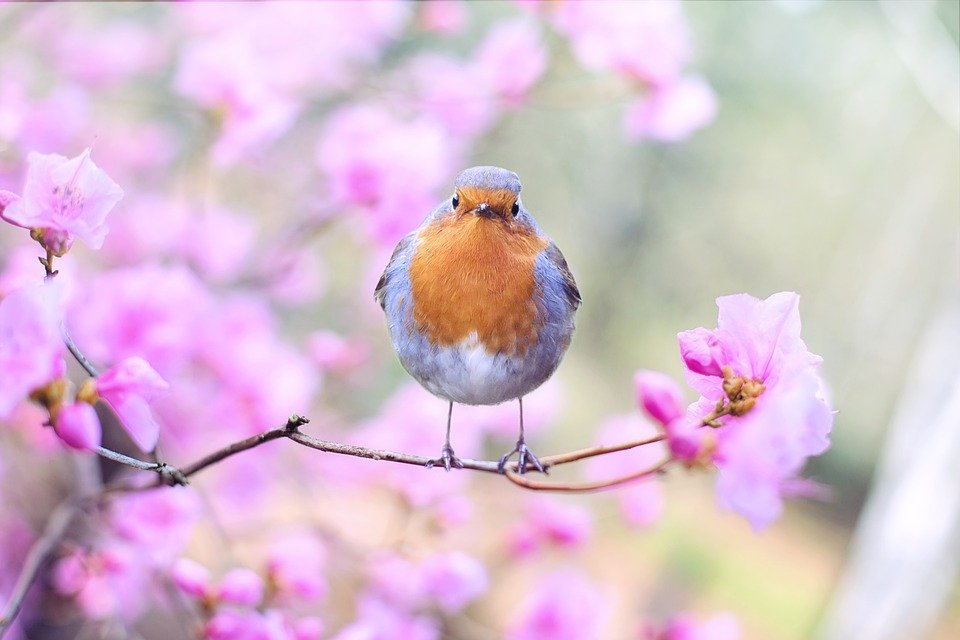
This has been a beautiful spring. I cannot recall a time in recent memory when I’ve noted so many dogwood flowers in the trees. Our daffodils have been more prolific as well. There is phlox and violets blooming throughout the yard. Since I know that it is through nature that God first reveals Himself to us (cf. Romans 1.20), I could not help if wonder if what I have been seeing is providential. Think about it. We are in the midst of a pandemic and have been asked to shelter in place. What if God providentially boosted the fertility of the spring to grab the attention of all of the people stuck at home? It is a nice thought, isn’t it? Certainly, those who’ve inherited the earth (Matthew 5L5) would take notice of that.

Yet, the truth is, I cannot say this with any degree of certainty. My statement about this spring’s beauty is contingent on the amount of attention I have paid to it this year as well as the joy I’ve experienced having more time to spend outdoors since “normal” life has been shut down. The thought has occurred to me that maybe every spring is as beautiful, I’ve just been too busy or distracted to notice. Perhaps, there were plenty of equally beautiful things that had existed but went unobserved.

Maybe you’ve heard of “Schrodinger’s cat.” This is a thought experiment proposed by physicist Erwin Schrodinger, based on idea he had gotten from Albert Einstein. I won’t bore you with the details. Suffice it to say, a poor kitty is imperiled by two deadly things inside a closed box. After an hour, you check to see if the cat has died. As crazy as it sounds, quantum mechanics allows for the cat to be both alive and dead until such time as one makes an observation; that is, until he or she opens the box. It is at the point of observation that the fate of the cat goes from superposition to a single state. If you find the thought experiment flawed, you’re not alone. Other physicists thought that it was ridiculous that a cat’s fate was contingent on whether or not we observed it. The radiation or the poisoned air would have killed the cat long before we opened the box. Another camp gave it a many-worlds interpretation. In other words, they say that upon opening the box, you as the observer become entangled with the cat on a quantum level and you both continue on in a reality in which the cat is either alive or dead. Since there are two possibilities, two worlds result in which the cat is alive and the cat is dead.

I apologize if I thoroughly confused you. Fortunately, it is not the wisdom of man that saves, but the wisdom of God (1 Corinthians 1.19-21). However, I referenced the thought experiment in order to frame my concept of a “Schrodinger’s spring.” God’s natural laws lead to a rebirth every year that He gives as we go from winter’s death to spring’s life. Because Christ sustains this creation (Colossians 1.15-17), we know that the promise God made with Noah will be kept (cf. Genesis 8.22). Hence, there will be “seedtime and harvest.” Yet, as I admitted about myself, there have likely been many years when I have failed to observe this unfolding process. There is a sense in which I allowed myself to be taken into a different world, one devoid of the joy God’s creation brings. We can do this when it comes to many different things besides nature, can’t we?

When I fail to note God’s providence and majesty, I create a world for myself that lacks contentment and joy. I don’t look to become satisfied with the state in which I am (cf. Philippians 4.11-13), but waste my life yearning for something else. We see the difference taking a moment to express gratitude made in the life of one former, Samaritan leper. Jesus had already cleansed his flesh, but extended forgiveness to him in response to the gratitude he had shown (Luke 17.18). A thankful heart is more predisposed to recognize the blessings of God, including the provisions made for our salvation. This is why, as with the cleansed Samaritan, it prompts worship. In what other way can we respond but with that desire to prostrate ourselves at His feet?

The next time you see the smiling face of the a child or a colorful sunset, remember “Schrodinger’s spring.” God has certainly surrounded you with blessings. It may be that in the hustle and bustle of life you simply haven’t had the time to notice. Make observations and change your reality as well.

spring-bird-2295436_960_720