“Love One Another”

Neal Pollard

One of my favorite songs, “The Greatest Commands,” starts with this imperative. As that song urges us, “Love is of God” (1 John 3:10). Having a divine source and being a command, it ought to really grab our attention. John explains by reinforcing why we should love one another.

IT IS AS OLD AS TIME (1 John 3:11-13). When a Bible writer leaves his own culture and goes back to the beginning, you know the subject is important. Jesus does this with marriage (Mat. 19:3-9). Paul does this with women’s role (1 Tim. 2:8-15). John does this with love. He takes us back to the edge of Eden, using Cain and Abel as examples. He implies that Cain killed Abel because he did not love his brother (12). He also is teaching that love is a work, not simply a feeling (12). He then shows us that Cain’s way is the world’s way (13). John will stress that following the Lord’s way is how we overcome the world (4:4; 5:4), and the Lord’s way is to love one another. 

IT IS A MATTER OF LIFE AND DEATH (1 John 3:14-16). It is a characteristic of the spiritually resurrected; it is how “we know that we have passed out of death into life” (14). We persist in a dead state if we do not love our brother (14). Hatred is the spiritual equivalent of murder (15; Mat. 5:21-26). At the other end of the spectrum, we know love by imitating Jesus and being willing to lay down our lives for the brothers (16). Building that kind of spiritual bond within the body of Christ matters so much to God! He wants us eliminating negative feelings, dissension, grudge-bearing, and animosity. He wants us building a spiritual bond that looks like the heart of Jesus, a heart that caused Him to go to the cross! What a challenge!

IT IS THE DIFFERENCE BETWEEN FAKE AND GENUINE (1 John 3:17-18). Saying “I love you” is incredibly easy. It is three one-syllable words. But our actions so often betray our claim. Do we literally put our money where our mouth is (17)? If we see our brother in need, whether financially, emotionally, socially, or spiritually, but show callous indifference, we need to go back to verse 10 and start reading again! The simple, powerful admonition is, “Little children, let us not love in word or talk but in deed and in truth” (18). In the context of works, James says, “If a brother or sister is poorly clothed and lacking in daily food, and one of you says to them, ‘Go in peace, be warmed and filled,’ without giving them the things needed for the body, what good is that? So also faith by itself, if it does not have works, is dead” (Jas. 2:14-16). Just like faith without works, words without loving action are dead and useless! It makes our “I love you’s” false and dishonest.

IT IS KEY TO OUR CONFIDENCE (1 John 3:19-24). John says, “By this…” (19). By what? By loving in deed and in truth. By loving in deed and in truth, “we shall know that we are of the truth and reassure our heart before him” (19). Look at all the conditional language in these verses. We should have confidence of our salvation if we love in deed and truth (19-21). We should have confidence that He will bless us and be with us if we keep this commandment to love one another (22-23). We should have confidence that we abide in God and He abides in us, if we keep His commandments (which includes, “love one another”)(24). John is not talking about cockiness or arrogance, but a blessed assurance that comes when we are striving to walk in the light (1:7). But, do not miss this point. Walking in the light necessitates brotherly love. You can’t have one without the other.

How should this change us? Won’t it kill grudges, feuds, avoidance, gossip, resentment, hostility, division, rivalry, suspicion, and the like? It will revolutionize the atmosphere of an entire congregation and the relationship between individual Christians in the congregation. It will draw us closer, into one another’s lives. Most of all, it causes us to imitate, please, and obey the God whose Son showed the greatest love of all (John 15:13)! 

The Bystander Effect

Friday’s Column: Learning From Lehman

chang

David Chang

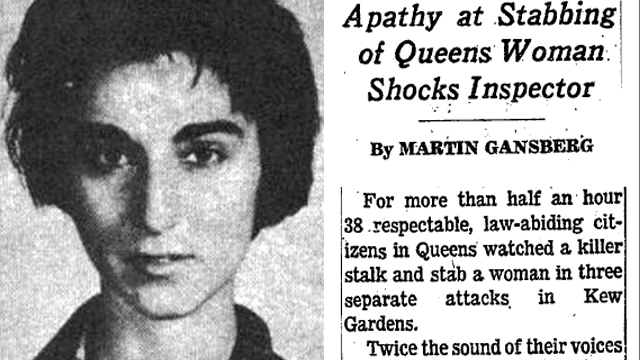
In the neighborhood of Queens, New York City, 1964, a young 28 year-old woman named Kitty Genovese was stabbed to death right outside of the apartment building where she lived. The reason this criminal incident is so well known is not because of the murder itself—as shocking as it was. The murder of Kitty Genovese is infamous because of the failure of every single one of the thirty-eight or so bystanders to take action to either stop the murder or call for help. Thirty-eight. Thirty-eight people were reported to have either seen or heard the murder happen, and yet not one person stepped in to help—or even called the police. Thirty-eight bystanders watched or listened on as Kitty’s life was taken from her that day.

This incident later became the foundation for the Bystander Effect or the Genovese Syndrome. Social psychologists Bibb Latané and John Darley, who popularized the Bystander Effect, attribute it to two factors: diffusion of responsibility and social influence. Diffusion of responsibility basically means that the more “bystanders” there are, the less personal responsibility an individual will take on. The reason teachers love small-groups is because it is harder for individual students to diffuse responsibility among a smaller group. It’s also the same reason students don’t like small-groups, because they can’t just hide in the crowd. They have to interact, answer questions, etc. Then there is the social influence, which basically means that you will do whatever the other bystanders are doing—or not doing. In the example of Kitty’s murder, those 38 bystanders saw no one else doing anything. Even though a murder was happening right in front of them, they failed to break the conformity of that immediate circle of thirty-eight people.

How many times have we done this in our faith life? How many times have we told ourselves that we can just hide in the crowd and not have to take action? How many times have we been so afraid of stepping out of line or going against the grain that we fail to live the way we are called to live? Let me ask you, how many times did Jesus step out of the social influence, the conformity of his religious peers, and the diffusion of responsibility among the crowd—to reach out and help those who are in need? He saw them as souls having value, rather than just another outcast of society. Jesus healed the sick and the blind. The blind man at Bethsaida (Mk. 8:22-26) and Bartimaeus outside of Jericho (Mk. 10:46-52). He treated women and children as if they were creations of God rather than some property or second class citizens. He healed them and welcomed them (Mk 5:21-43, Mt. 19:13-15, Lk. 7:11-17). He approached lepers, the ultimate example of social outcasts, and treated them with civility and mercy (Mk. 1:40-45, Mt. 8:1-4, Lk. 5:12-16; 17:11-19). He touched them and healed them, something not even the priests would have dared to do. Jesus subverts our expectations at every turn, and he breaks conformity at every opportunity. He is not paralyzed at the sight of someone in need; he springs into action, and continues to work even today. When we are helpless and in need, our cries do not fall on deaf ears—not as long as Jesus is alive. And he is alive and working today.

We are called to be like Christ, and part of that calling is to break free from conformity and social influence (Rom. 12:2). We are not called to hide in the crowd. Never should our personal responsibility of righteousness and good works be diffused among the crowd. We must not have a “someone else will take care of it” mentality…ever. 

I wonder if there were any Christians among the thirty-eight bystanders who watched and listened as Kitty Genovese was killed. May we never just be another bystander. May we never let evil and falsehood prevail in our presence. I pray that we all will work to break free from the paralysis of the bystander effect, and take action, every one of us, for Christ and his Kingdom.

You know, there is a positive aspect of the Bystander Effect. Just as people are negatively affected by the diffusion of responsibility and social influence, even those can be flipped to have a positive effect. All it takes is a few people to break that social influence, and spring into action. Then the other bystanders will be pulled to spring into action themselves. It is contagious. When those few break out, it breaks the spell of the bystander effect. 

Christ calls all of us to be those few who will break the paralysis. However, we cannot break the conformity while still being a part of the world. We must first break away from the world and become one with Christ through repentance and baptism. Even after that initial step, the job is not done. As a Christian, we cannot just return to standing in the crowd as a bystander. Do not be a bystander; an onlooker; just another body in the endless sea of spectators. Remember that Jesus never froze up at the sight of suffering or need. As Jesus first broke through to reach us while we were still in sin, let us also break free from the paralysis of the bystander, and spring once more into action.