“It’s the end of the world…And I feel fine”

Brent Pollard

A “guilty pleasure” is something that one enjoys despite believing other people don’t generally value it or think it’s strange or unusual. It often implies enjoyment of something that societal standards may view as low-brow or embarrassing, but the individual finds personal enjoyment in it regardless. This pleasure could be a specific type of music, a television show, food, or any other enjoyable activity that might not be considered “sophisticated” or “appropriate” by some. 

Embarrassment or the acknowledgment that one’s enjoyment may not be socially acceptable causes the feeling of guilt. At the same time, “pleasure” indicates the personal joy or gratification one gets from it. Therefore, “guilty pleasure” does not always mean something unethical or immoral. It’s more about finding value in something that society frowns upon or labels as “low culture,” “kitsch,” “campy,” etc. 

Rather than being due to actual wrongdoing, guilt often results from a contrast with one’s usual standards or tastes or from a perception of the judgment of others. The concept of guilty pleasure is widely recognized and accepted as a regular part of human behavior. Hence, whether you realize it or not, you likely have a few guilty pleasures too.

Dystopian and disaster scenarios are some of my guilty pleasures. I’ll use the 2004 apocalyptic thriller The Day After Tomorrow as an illustration. It nicely sums up Al Gore’s and Greta Thunberg’s exaggerated climate alarmism. But even Roland Emmerich, who brought us Independence Day, couldn’t find mainstream success with his ludicrous environmental doomsday epic. A 50% audience score and a 45% Tomatometer score on Rotten Tomatoes explain why it’s one of my “guilty pleasures.”

Recently, I came across “Doomsday: 10 Ways the World Will End” on the History Channel. As I had a little time on my hands, I gave it a watch. I was not disappointed. Having Michio Kaku as a guest on the show was a highlight for me. I can’t put my finger on why I find him so intriguing. Therefore, I pause the remote and pay attention whenever I see his face. This series had everything in its ten hypotheticals, from a mega eruption at Yellowstone to the Earth being pulled out of orbit and hurtled into the sun.

I smiled wryly as I listened to an anthropologist with huge gauges in his earlobes describe how the latter scenario would result in a gradual temperature rise that would eventually engulf the planet in “hell.” I couldn’t help but notice that the only time producers used Bible-related terminology was about a place of eternal punishment “where their worm does not die, and the fire is not extinguished” (Mark 9.48 NASB). 

I wonder why I find it entertaining to watch things that I know to be implausible and ridiculous. I should swallow my pride rather than end up sounding like that Pharisee in the Temple. “God, I thank You that I am not like these academics who do not believe in You.” More than likely, I use my guilty pleasure to reassure myself that everything will be fine. 

I’m not a natural salesperson. The sales commission I make would not be enough to support me. However, I have studied materials on success in a cold sale. A sale that has no prior leads is considered “cold.” You are going up to a total stranger and trying to make a sale. You may see why an evangelist would read such a book out of curiosity. 

Imagining the worst-case scenario is one strategy for buffering the emotional impact of rejection. You might, for instance, imagine a situation in which, after you’ve formally introduced yourself to the homeowner, he goes off and punches you in the face for no apparent reason. If the person says “no” to your sales pitch, you can console yourself by thinking, “Well, at least he didn’t punch me in the face.” This method is great for calming your nerves.

When I watch a doomsday scenario movie or documentary, I immediately notice that the show’s producer has overlooked one crucial factor: the existence of God. God’s existence ensures that nature always follows its laws. Hence, Earth will not experience any disturbance in its orbit. Instead of suggesting that past eruptions in Yellowstone indicate a repeat occurrence, this evidence is more consistent with the mechanisms God used to destroy the world in a global deluge. Although mankind can make life on Earth quite unpleasant, only God has the power to wipe out all human life forever. In the meantime, He has promised that the cycle of planting and harvesting, cold and warmth, summer and winter, day and night, will never end (see Genesis 8.22).  

Perhaps you don’t enjoy watching disaster films or documentaries. I understand. But maybe this will help you see why I refer to this as one of my “guilty pleasures.” I know you will agree that God’s promises are worth holding on to. When fear overwhelms you, even if it seems irrational, remember to take solace in the words we attribute to the sons of Korah in Psalm 46.

“God is our refuge and strength,
A very ready help in trouble.
Therefore we will not fear, though the Earth shakes
And the mountains slip into the heart of the sea;
Though its waters roar and foam,
Though the mountains quake at its swelling pride.” (Psalm 46.1-4 NASB)  

Alone!

Neal Pollard

Kathy and I very recently discovered an interesting show produced by the History Channel, and the title of the series is “Alone.” It is a “reality show” (not usually a fan of those), but it involves survival experts dropped, alone, in the middle of nowhere. They get to take ten items of their choice to help them battle predators, the elements, and, most of all, isolation. Food, water, shelter, and fire top their priorities, but even having these cannot prevent the maddening monotony of being deprived of human companionship.

I love the way Solomon says it in the book of Ecclesiastes. “Two people are better off than one, for they can help each other succeed. If one person falls, the other can reach out and help. But someone who falls alone is in real trouble. Likewise, two people lying close together can keep each other warm. But how can one be warm alone? A person standing alone can be attacked and defeated, but two can stand back-to-back and conquer. Three are even better, for a triple-braided cord is not easily broken” (4:9-12, NLT, emph. mine). At the very beginning, God made it clear that it isn’t good for man to be alone (Gen. 2:18). Alone one is in trouble, in the cold, and in danger. It is not good for us.

The survivalists on the show figure that out. So does the person, even with people all around them, who keep themselves in isolation. Think of all the ways God combats our loneliness.

  • He gives us marriage (Gen. 2:18; 1 Cor. 11:9).
  • He gives us children (Psa. 127:3-5).
  • He gives us the church (Eph. 2:19).
  • He gives us the assemblies (Heb. 10:24-25).
  • He gives us fellowship (Acts 2:42).
  • He gives us hospitality (Rom. 12:10,13).
  • He gives us counselors and mentors (Prov. 15:22; 24:6; Ti. 2:3-4).
  • He gives us the aged (Lev. 19:32; 1 Tim. 5:1).
  • He gives us shepherds (Acts 20:28).

Life is difficult for the person determined to go it alone! We are left with our thoughts, which may or may not be accurate reflections of reality or at least the whole picture (Prov. 18:17). We are deprived of the very resources God has given to help us successfully overcome life’s challenges. It is an easy habit to get into to withdraw from the company of others, but it is not healthy! We need others, and, just as much, they need us!

The guys on the reality show voluntarily go it alone for money and notoriety, but, even with that incentive, the loneliness gets unbearable. For us, the prize and reward does not require us to cloister ourselves. It requires the opposite! May we never choose to be alone, when we have so many tools supplied by God to survive the challenges of this life.

“Aliens”

Friday’s Column: Brent’s Bent

Brent Pollard

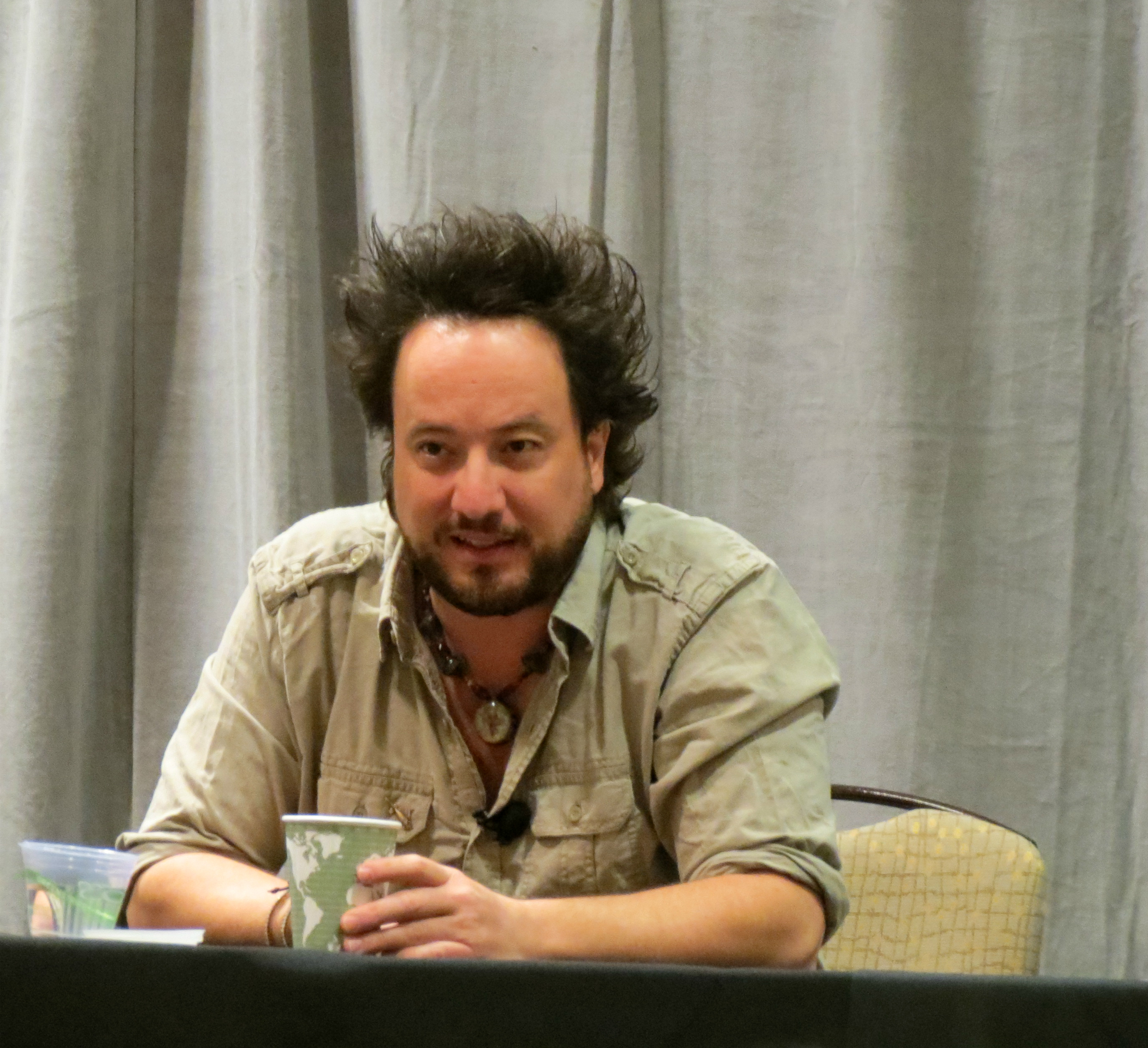
An older internet meme, originating in 2010, features Giorgio A. Tsoukalos from the History Channel’s Ancient Aliens program.1 As Tsoukalos believes ancient astronauts visited our planet in our distant antiquity, he often speaks enthusiastically about how such extraterrestrial visitors interacted with our remote ancestors. Hence, a screenshot of Tsoukalos from Ancient Aliens sporting his crazily coiffed hair and hands frozen in mid-gesticulation conveys the simple message to the viewer of “Aliens.” Another version of the meme, also featuring the same screenshot of Tsoukalos, reads, “I’m not saying it was aliens, but it was aliens.”  

What is the point of posting random pictures on the internet? Honestly, what is the purpose of any meme? The word “meme” derives from the Greek word “mimeme,” meaning something imitated.2 Without becoming too bogged down in explanation, a meme is a vehicle by which internet posters convey ideas. Then, others who identify with the message share it. In that simple act of reposting, one “imitates” the intent of the meme’s creator. When many people do this, we proclaim that the meme has “gone viral.” However, the power of the meme is that it will invoke a response so that even those angered by it will respond to it. For example, the “Aliens” meme is employed by those jokingly offering a Deus ex machina-type explanation for things to which we may or may not have the answers. How did ancient builders erect megalithic structures? Aliens. Who ate my last donut? Aliens. 

I cannot help but hear the voice of Giorgio A. Tsoukalos saying “aliens” in my head as I read headlines like this one from Yahoo!News: “How would humans respond to the discovery of aliens? NASA enlisted dozens of religious scholars to find out.”3 For some reason that escapes me, Hollywood has often speculated that the revelation of extraterrestrial life would destroy the faith of believers. You have likely seen such movies. There is typically some cabinet member telling the fictional President to keep things quiet lest the disclosure of the existence of extraterrestrials leads to chaos. By the way, rather than becoming terrified by the thought of aliens, the article suggests that religious people would most likely be better prepared to receive such visitors from afar. I agree with that conclusion. 

I cannot speak for other Christians, but I can say why I wouldn’t lose my faith in Jesus Christ because someone proves that the Roswell greys exist. First, my belief that God created everything that exists convicts me of the truth that if “aliens” also exist, God created them too. Genesis 1 details how God made the heavens with their inhabitants. A Christian realizes that, though the creation account mentions nothing about planets, the voice of God made Jupiter and Saturn, which are planets. Would it require more faith to believe that there could be one planet orbiting a star capable of supporting life in that sea of stars we see at night? No. Again, Genesis 1 tells us God created the heavens and the earth. It would be more a matter of what God has chosen to reveal to us. Deuteronomy 29.29 reminds us that God has only given us what He has revealed. The secret things belong to Him alone.  

Second, we ask what we can even understand about God apart from His Word. Isaiah 55.8-9 reminds us that the thoughts and ways of God are above our own. Science fiction author Arthur C. Clarke once stated what has since become known as one of Clarke’s Laws: “Any sufficiently advanced technology is indistinguishable from magic.”4 We might substitute the word “supernatural” for “magic.” The existence of aliens would not destroy my faith because I might ask whether the strange phenomena I was witnessing were not “aliens” but “heavenly visitors.” Maybe Ezekiel’s “wheel in the middle of the wheel” was a UAP (Unidentified Aerial Phenomena) (Ezekiel 1.4ff). Would it matter to you if God created the universe using advanced technology to which only He has access? Either way, He has the power to create and destroy us (cf. 2 Peter 3.12). 

Ultimately, all of this talk has more to do with scientists’ expectations regarding the recent launch of the James Webb Space Telescope.5 In addition to thinking they will see the Big Bang, scientists believe we might finally see those elusive extraterrestrials and life-sustaining planets. And why not? The government has even declassified reports about the existence of “Unidentified Aerial Phenomena.”6 Having said what I have about not having my faith shaken by the sudden revelation that there is other life out there, though, I find it more likely that each discovery reveals what we have known all along. God placed us in a particular spot within the cosmos to see His intelligent design and realize, yes, it had a beginning. It is not eternal. And one day, we will meet Him, Who created it all.   

Sources Consulted and Cited 

1 “Ancient Aliens.” Know Your Meme, Literally Media Ltd., 3 Dec. 2021, knowyourmeme.com/memes/ancient-aliens

2 “Memes | Psychology Today.” Psychology Today, Sussex Publishers, LLC,www.psychologytoday.com/us/basics/memes

3 Snodgrass, Erin. “How Would Humans Respond to the Discovery of Aliens? NASA Enlisted Dozens of Religious Scholars to Find out.” Yahoo! News, Yahoo!, 29 Dec. 2021, 21:42,www.yahoo.com/news/humans-respond-discovery-aliens-nasa-024208831.html

4 Jones, Andrew Zimmerman. “What Are Clarke’s Laws?” ThoughtCo, Aug. 26, 2020, thoughtco.com/what-are-clarkes-laws-2699067

5 Griffin, Andrew. “James Webb Space Telescope Latest: Alien-Hunting Spacecraft Unfurls on Its Way to Study the Universe.” Yahoo! News, Yahoo!, 30 Dec. 2021, 09:42, news.yahoo.com/james-webb-space-telescope-latest-144238287.html

6 Preliminary Assessment: Unidentified Aerial Phenomena. www.dni.gov/files/ODNI/documents/assessments/Prelimary-Assessment-UAP-20210625.pdf