Petrified!

Neal Pollard

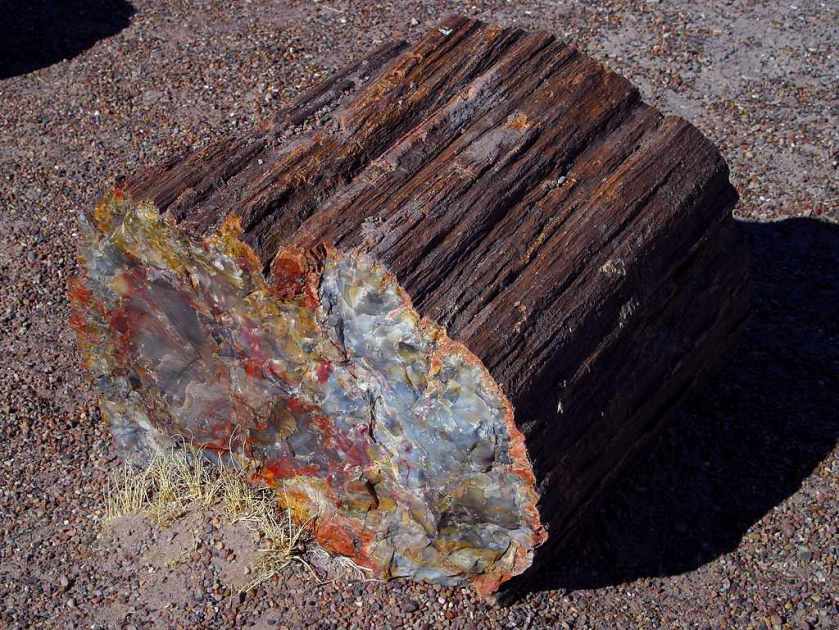
Perhaps you have seen the incredible collections of petrified wood in some of our National Parks or Monuments, or maybe you have seen individual examples in any number of other places. A geology site briefly explains how material becomes petrified:

Petrified wood is a fossil. It forms when plant material is buried by sediment and protected from decay by oxygen and organisms. Then, groundwater rich in dissolved solids flows through the sediment replacing the original plant material with silica, calcite, pyrite or another inorganic material such as opal. The result is a fossil of the original woody material that often exhibits preserved details of the bark, wood and cellular structures (geology.com/stories/13/petrified-wood).

There are a few interesting aspects to this process—the burial, the protection, the replacement, and the resulting appearance.

Twice in the gospel of Mark, the writer uses a term to describe the condition of His disciples’ hearts. In Mark six, they have seen him feed the 5,000 men and immediately thereafter they are in the boat in a strong wind when Jesus came walking on the water. They were troubled and fearful, amazed and marveling “for they had not gained any insight from the incident of the loaves, but their heart was hardened” (52). Ironically, the second incident happened in a boat following Jesus feeding thousands of people again. They misunderstand Jesus’ warning about the leaven of the religious leaders, and Jesus laments, “Is your heart still hardened?” (8:17).

BDAG defines this word, πωρόω, in this way: “To cause someone to have difficulty in understanding or comprehending, harden, petrify, make dull, obtuse, blind, close the mind” (900).  The truth was buried from their understanding, their preexisting, preset points of view blocking its penetration, and the result was their missing the important point. The truth couldn’t get through to their petrified hearts.

Why do we fail to understand basic, vital Bible truths, like the essential nature of baptism, the abrogation of the Law Of Moses (including the Ten Commandments), the emotionally difficult teaching of Jesus about marriage, divorce, and remarriage in Matthew 19, God’s law regarding sexual purity, and the like? Why do we struggle with worry, fear, and doubt? Why do we lack the courage to boldly share Jesus with the lost? Often, the answer to each of these and similar questions is the same as why the disciples feared and faltered.

We should pray for our hearts to stay soft, receptive, and moldable to Jesus. We cannot let our ignorance, resistance, or outside influences to harden our hearts. In fact, that very prospect should make us, well, petrified!

petrifiedwood

Is It Scriptural To Use Alcoholic Wine In The Lord’s Supper?

Neal Pollard

This is a question that occasionally comes up and is an important matter to consider since for some this is a test of a teacher’s soundness and a matter of fellowship.  As the church is global in nature, it is a matter to consider beyond the borders of our nation.  Various biblical arguments are made to defend and condemn its usage.

No doubt, the practice of “social drinking”—which is a different discussion altogether—has created such sensitivity to this matter of what kind of fruit of the vine is permissible for communion.  Achieving a biblical answer is vital, though, especially if the matter is framed as something that might be “scriptural” or, by implication, “unscriptural.”  If Guy N. Woods is right on this very matter, “To urge the use of one, to the exclusion of the other, on alleged scriptural grounds, is to make a law where God made none. It is a grave sin so to do (1 Tim. 4:3)” (Questions And Answers: Open Forum, 1976, p. 361).  Were his statement to be found true, those who malign the character of those whose position differs from their own should refrain and retract.  This is not a matter of what is preferred or deemed most expedient, but is a matter of what Scripture permits.

Arguments Against Its Use:

  • The Passover Meal.  Jesus instituted the Lord’s Supper during the Passover before His death (Mat. 26:26-29).  Drawing from the idea that during the Passover no leaven was to be in one’s house for seven days (Exo. 12:19), it is assumed that wine would be prohibited.  Even if such were to be proven true (and it cannot be), we should remember that what proves too much proves nothing at all.  During the Passover, they also ate roasted meat (Exo. 12:8) and bitter herbs (Exo. 12:9).  In addition, the “leaven” forbidden in the Passover was dough used in baking bread (Koehler, et al; The Hebrew and Aramaic lexicon of the Old Testament, 1999, n.pag.) and the prohibition is specifically “eating” that which contained leaven (cf. Exo. 12:15; Deu. 16:4). Wayne Jackson shows that “wine was ordinarily used at the Passover and is called ‘fruit of the vine’ in Berakoth 6:1” (https://www.christiancourier.com/articles/224-was-the-fruit-of-the-vine-fermented, citing Jack Lewis and John Lightfoot).  The Passover Meal cannot be used as grounds for prohibiting the use of wine in the Lord’s Supper.
  • 1 Timothy 5:23.  It is argued that since Paul had to tell Timothy to drink wine for  medicinal purposes, Timothy could not have, as a Christian who faithfully worshipped, consumed fermented fruit of the vine in partaking of the Lord’s Supper.  This assumes what the text of Scripture nowhere supports.  That Paul is condoning the medicinal use of alcohol, given the medical conditions of the day, is clear.  But, this text is neither in the context of the Lord’s Supper nor a judgment in any way on what should be used in it.  One flirts dangerously close to “twisting” the Scriptures who applies this passage to the communion (cf. 2 Pet. 3:16).
  • Causing A Brother To Stumble.  This is a legitimate concern and should factor into our judgment regarding the Lord’s Supper.  The church has recovering alcoholics and others who struggle with a sin problem regarding alcohol.  A newer convert or one whose conscience is sensitive in this matter should be respected.  Romans 14 is devoted to discussing such a matter as this. However, having scruples about a matter does not give one the authority to make his or her scruples law.  Choosing to impose fermented wine just because one can, ignoring the impact this has on a brother’s conscience, falls into the category of causing a brother’s stumbling.  However, difficulty in obtaining grape juice in many parts of the world at times makes necessary using alcoholic fruit of the vine.  In this case, the Lord’s command takes precedence over a brother’s conscience.  The church is commanded to observe the Lord’s Supper (1 Cor. 11:23-29), with the approved example of Acts 20:7 teaching us that such is to be done every first day of the week.

This article is not intended as advocacy to implement the use of alcoholic fruit of the vine in our communion services here in the states or developed nations where there is ready access to non-alcoholic fruit of the vine.  The bigger question is permissibility in situations where such is unavoidable or even where the autonomous judgment of the local church allows its usage. By extension, is it right to label a congregation liberal or sinful who chooses to use it in the Lord’s Supper?  At its heart, this is not a matter of what we might think is wiser, more expedient, or more comfortable.  The question is whether a congregation has the biblical right to do so.  In many of the world’s more remote and rural areas, the ability to get non-alcoholic fruit of the vine is a real problem.  For them, this is a real, practical concern.  Short of compelling information which I have, as yet, not seen, it seems clear that it is scriptural to use alcoholic wine in the Lord’s Supper.

The Origin Of Scruples

Neal Pollard

Wes Autrey gave me an incredibly cool book by Charles Earle Funk.  The title of it is, “Thereby Hangs A Tale.” The book divulges the origin of words in modern usage, a study known as etymology. The fascinating explanations of many of our words is virtually endless, but the origin of our word “scruples” is particularly interesting.  Apparently, the Romans were prone to get sharp pebbles in their sandals.  They called those “pointed bits of stone” scrupulus. Funk says, “It is easy to see how the uneasiness one would feel from a pebble in the sandal gave rise to the figurative use of scrupulus for an uneasiness of the mind” (254).  In time, scrupulous has come to mean “extreme caution and carefulness.”  Scruples are “a feeling of doubt or hesitation with regard to the morality or propriety of a course of action.”

There is a connection between scruples and conscience.  It is the conscience that informs our scruples.  Our sense of right and wrong determines our caution, care, and even hesitation when we are in a given situation.  How sharp our conscience is effects how scrupulous or unscrupulous we are.

The Bible does not use the word “scruples,” but the word “conscience” is mentioned 27 times in the New Testament alone. Some people’s conscience forbids them to do what may be acceptable (cf. 1 Cor. 8:7), but others’ consciences allow them to do what is forbidden (Acts 23:1; 1 Tim. 4:2). Thus, the goal is for us to properly train and adequately sharpen the conscience.

What helps in this process is growing close to God by communing with Him in Scripture, application of Scripture, and prayer.  As we walk the narrow way, we want to feel the pain of those “pebbles” that may keep us from finishing the journey.  Is this not the idea conveyed by the writer of Hebrews, who says, “Let us also lay aside every encumbrance and the sin which so easily entangles us, and let us run with endurance the race that is set before us” (Heb. 12:1).  That rock in the shoe may be some ethical or moral practice that ultimately takes us off course.  Let us be careful to gauge the morality or propriety of any course of action, making sure it is in harmony with the goal of eternal life and not more likely to ultimately lead us away from God.