What Will Others Say Mattered Most To Me?

Monday’s Column: Neal At The Cross

I have preached nearly 100 funerals in my 31 years of full-time preaching. That includes funerals for still-borns all the way up to those 100 years old. It includes services for those who committed suicide or died in accidents, but also a great many who were able to prepare for the process of dying. 

In the course of sitting down with families who have just lost a loved one, it is commonplace to talk about the deceased. Sometimes, I have known and been closely tied to the one whose service I was doing. Other times, I have not known them well and it is not uncommon to perform a service for someone I’ve never even met. Meeting with the family is a great way, especially in these situations, to find out who their loved one was. 

The longer they talk and the more they say, the more clearly they paint a picture of what the dear departed prioritized. The stories center around that theme. All of them want the preacher to know some “faith fact(s)” about them–they were raised in the church, they believed in God, they read (or had) a Bible, etc. Some of them have an abundance of stories about a Christ-centered life. All roads seem to lead back to that: Family stories, work stories, and church stories. 

Sadly, others paint a picture of other things predominating their time, passion, talent, and interest. At a time when people are going to say the nicest things about a person, they are also going to give away what mattered most to them–during the visitation, before, during, and after the service, at the graveside, and otherwise. It always happens.

Most days, our funeral is the farthest thing from our minds. We are busy living life. Yet, we are building, day by day and decision by decision, what our legacy will be. In the book of Ecclesiastes, Solomon talks about the many things that are “vanity.” He uses the word 38 times in 30 verses, at times using the phrase “vanity of vanities” to express utter futility and worthlessness. Work, knowledge, pleasure, competition, money, everything, apart from God, is like chasing the wind. 

At the end of his sermon, this wise king says, “The conclusion, when all has been heard, is: fear God and keep His commandments, because this applies to every person. For God will bring every act to judgment, everything which is hidden, whether it is good or evil” (12:13-14). What an encouragement to you and me to build a God-centered legacy. That requires embracing what Jesus taught, to seek first God’s kingdom and His righteousness (Mat. 6:33). Don’t we want others, most importantly God, to say, our faith defined us? Nothing matters more! 

Neal Pollard

The Parable of the Lost Coin

Friday’s Column: Learning From Lehman

IMG_3998

Kason Eubanks

A little boy was riding his bike in the cemetery while his mother ran.  Obviously this mother isn’t very bright because who in the world runs in a cemetery surrounded by dead bodies.  Anyway, this boy rode his bike along the path and eventually could not find his mother.   After looking and calling for her, he became frantic.   His mother was also frantic at the far end of the cemetery. She picked up her pace and ran to retrace her steps. The further she ran the more frantic she became. Almost in tears she saw no sign of the little boy. She ran to the gate leading out of the cemetery. And that is where the little boy was. The boy was very young and I don’t know a lot about this story but what I do know is that I have a lifelong fear of cemeteries.

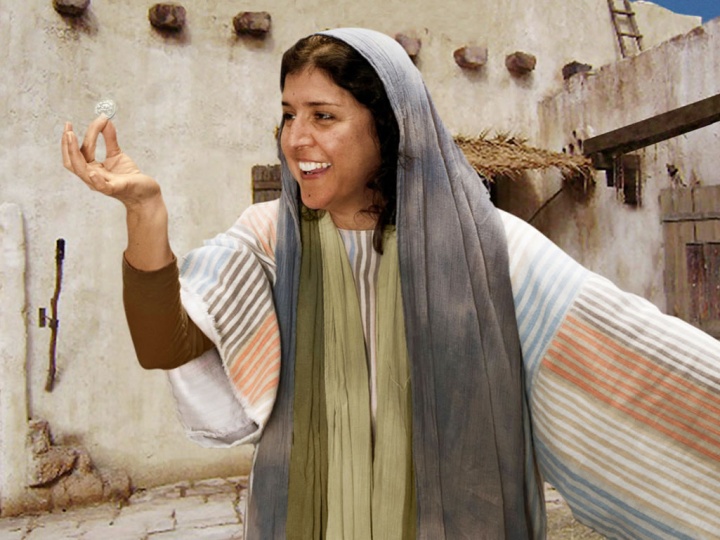
The Parable of the Lost Coin

We read about a woman in Luke 15:8.  It states, “Or what woman, having ten silver coins, if she loses one coin, does not light a lamp, sweep the house, and search carefully until she finds it? And when she has found it, she calls her friends and neighbors together, saying, ‘Rejoice with me, for I have found the piece which I lost!’  Likewise, I say to you, there is joy in the presence of the angels of God over one sinner who repents.” This woman in the parable of the lost coin lit a lamp.  She uses the light to see. She knows the light is what she should follow to find the coin.  She also swept the WHOLE house.  She uses her physical energy to find the coin.  She doesn’t wait for the coin to just reappear; she puts effort into looking for it, and she receives her reward by finding the coin.  She spends time rejoicing with her neighbors.

If you lost a coin, would you search your whole house? Would you turn your house upside down just to find one coin? If I lost a coin I would not care one bit about that one coin that I lost. Matter of fact, I have lost a bunch of coins and I have never swept the house just to find them.  

It may be that you haven’t searched for God so you can have a home in heaven in the end, and maybe it is that you want to fix that issue. Or maybe you need to get your life on track. Whatever your need may be, do not remain lost! 

“She Had Difficulty Accepting Death”

Neal Pollard

Each death marks a transition and passing of an era. The recent death of Doris Day certainly represents this well. The 97-year-old had a stipulation in her will that she not have a funeral, memorial service, or grave marker. She did not want a lot of time spent memorializing her death. She didn’t like death, and, as her manager and friend, Bob Bashara, told reporters, “She had difficulty accepting death” (Tyler McCarthy, FoxNews.com).

Most of us won’t refuse a burial plot and funeral service, but few of us enjoy imagining the process or moment of death in our lives. There is something sobering and precious to us about at least our own lives and mortality. We think it is unhealthy and unusual for someone to have little or no regard for their lives.

Sometimes, we struggle to accept the death of someone else. For how many years have people been in denial about Elvis Presley’s death, thinking him to be living in hiding somewhere. Though she would be dead of natural causes today, many, for years, chose to believe that Amelia Earhart did not die but rather landed on some deserted island or similar conspiracy. Don’t even get me started on Jimmy Hoffa. No compelling evidence was enough to convince ardent fans that these notorious people were actually dead.

Did you know that some people have tried to say that Jesus did not actually die, but only “swooned” on the cross? It’s even called the “Swoon Theory.” The Koran says that he feigned death (Surah IV: 157) and others say Jesus was drugged and only appeared dead (Geisler 347). But, as Geisler notes, there were experienced Roman soldiers there, there was significant blood loss from many wounds that bled for hours, there was an outpouring of blood and water when Jesus’ side was pierced, the governor, Pilate, inquired into the fact of His death before He turned over the body to Joseph of Arimathea, and much more sufficiently prove that Jesus actually died on the cross (ibid 347-348).

Each Sunday, we readily embrace the fact that Jesus died. In fact, we base our entire lives upon the truth of that death. We understand that it was necessary for Jesus to die, in our place and for our sins (Rom. 14:9; 2 Cor. 5:15; 1 Pet. 3:18). Though it breaks our heart that it was necessary for Jesus to die, we do not have difficulty accepting it. We’re counting on it! As you memorialize the Lord in the Supper today, be grateful for that substitutionary death. He was able to do for us what we could not do for ourselves (2 Cor. 5:21). Of course, what makes the difference in our eternity is that He did not stay dead. He arose (1 Cor. 15)! But, He wants us to embrace His death and let us change who we are and what we do.

doris-day-401256_960_720