Haunted Ruins

Dale Pollard

Perhaps Nimrod’s extraordinary ability to hunt was partly responsible for the reason why so many were inclined to stick close to him and construct a tower amidst the ruined site of early Babylonia (or Shinar, Genesis 11:2). He’s a hunter after all and apparently an excellent one (Genesis 10:8-12). There’s a phenomena that’s been observed in nature where carnivorous animals like lions and crocodiles develop a “taste” for human flesh. They’ll begin to actively hunt people for a number of reasons but it’s been known and documented in several predatory species. Since animals acted as they do presently after the flood (Genesis 9:2), then it’s logical to assume that all of that death caused by the deluge attracted numerous carnivores to settlement areas early on.

Theoretically, aquatic animals and eventually the land dwelling predators would have had ample opportunity to develop that “taste” for humans. If that were the case, it makes even more sense why earth’s population had a difficult time spreading out over the earth as earth would have been more of a challenge to subdue and dominate than it was before (Genesis 1.28). Mankind may have dominion over the animals, but Job knew there were at least a few exceptions to this (Job 41:1-4). Ferocious man-eaters would have made first settlements more vulnerable but sticking together under the leader of a great hunter makes perfect sense— at least on the surface. 

After the birth of Babel the Bible sheds light on its death and lasting memory. Eventually, wild creatures would inhabit the ruins of Babylon and other cities after God’s judgment (Isaiah 13:21, Isaiah 34:13-14). 

The specific animals mentioned in these passages and similar ones remain unknown, but are often translated as “ostrich” and “jackal.” Interestingly enough, the Hebrew word used for “jackal” is also used to refer to dragons in the same book of Isaiah. (Isaiah 27:1). 

The following verses are even more haunting:

“Babylon shall become a heap of ruins,
the haunt of jackals,
a horror and a hissing,
without inhabitant…
The sea has come up on Babylon;
she is covered with its tumultuous waves.
Her cities have become a horror, a land of drought and a desert, a land in which no one dwells, and through which no son of man passes.
And I will punish Bel in Babylon,
and take out of his mouth what he has swallowed.
The nations shall no longer flow to him;
the wall of Babylon has fallen” (Jeremiah 51:37, 42-47). 

It seems that the second destruction of Babylon was foreshadowed by the first destruction during the deluge. Tragically, the name of the once great city would  nearly becomes synonymous with “the end,” especially in Revelation. 

“And he called out with a mighty voice,“Fallen, fallen is Babylon the great! She has become a dwelling place for demons a haunt for every unclean spirit, a haunt for every unclean bird, a haunt for every unclean and detestable beast” (Revelation 18.2). 

Babylon’s downfall serves as a true tale of caution for us today as God allows the rise and fall of every nation— even setting their boundaries (Acts 17:26). No matter how great a nation becomes it will never become greater than the One who allowed its very existence in the first place. 

Long-Living Legends

Dale Pollard

Long-Living Legends 

According to the book of Genesis, the Antediluvian (pre-flood) humans once lived extraordinarily long. Adam was 130 when he had his first son Seth who lived to 912. Seth’s great-great-great-great-grandson, Methuselah, is the oldest man on the biblical record— dying at the ripe old  age of 969. 

For perspective, 969 years ago from the point of this writing (Monday, November 27, 2023) was Monday, November 27, 1054 A.D. If mankind had continued to live that long through the modern era, Christopher Columbus would still be alive today and wouldn’t die for another 400 years! 

How The Ancients Aged 

Some have speculated that a canopy made up of water vapor once surrounded the earth but then it collapsed at the time of the flood. Interestingly, five of the nine planets in our solar system have thick cloud canopies including Venus which is closest to earth in both size and distance. The water canopy before the flood could have been attributed to the long lifespans of early humans by blocking out harmful radiation and producing higher oxygen levels, much like a greenhouse. 

This could also be the reason why people post-flood slowly began to live shorter lives like Terah, the father of Abraham, who lived for only 205 years.The  atmosphere would not only have added many years to life, but it was also conducive for massive growth. Everything from plants to animals were larger versions of their modern counterparts. For instance, fossils of Glyptodons (ancient relative to the armadillo) could weigh around 4,000 pounds and reach lengths of 5 feet. 

Non-Canonical Coincidences 

The Sumerian King List records the lengths of reigns of the kings of Sumer. The initial section deals with kings before the Flood and it begins with their oldest rulers reigning for thousands of years but their later kings live significantly shorter. While the Bible doesn’t mention anyone living for thousands of years, it’s intriguing to find more ancients who have documented such lengthy lifespans— even if exaggerated. 

In ancient Persian legend, the fourth king of the world was a man named Jamshid and he was said to have reigned for 700 years. He was a great inventor and during his reign people neither sickened nor aged.

Putting Hope In God’s Plan

Gary Pollard

I Pt 3.19 is a difficult verse on its face, but it’s easily explainable. It’s tied to 3.18, “His physical body was killed, but he was brought back to life in spirit.” 3.18 simply says that he also used God’s power to help Noah tell everyone that a global flood was imminent. All but 8 people were killed in the flood because they refused to listen. Those “spirits now in prison” are identified clearly as those who lived in the antediluvian world. 

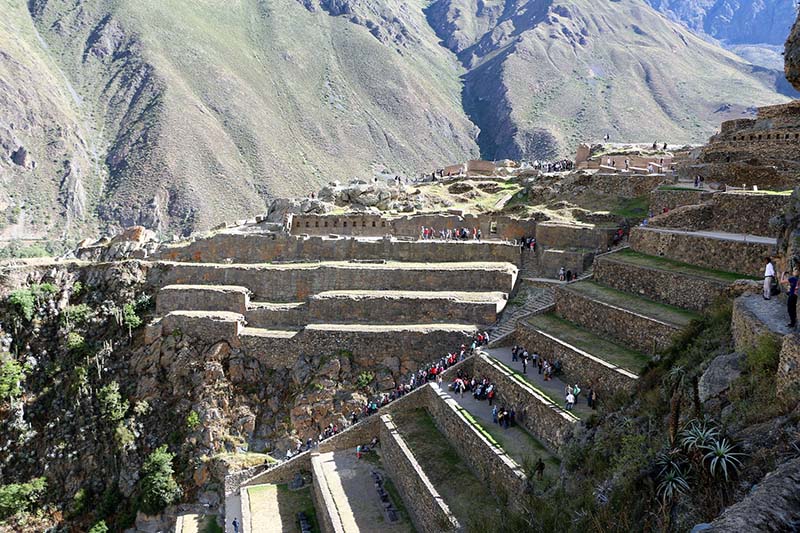
Interestingly, many megalithic structures around the world (Ollantaytambo, Barabar, Ajanta, Ellura caves, Puma Punku, the city of Petra, Derinkuyu, Saqsaywaman, the Great Pyramid of Giza, etc.) show strong evidence of having been built before the flood. Several of these seem to have been designed specifically to protect against a doomsday scenario. We know all people were warned about the flood, but it seems most preferred to put their trust in stone rather than a wooden boat. 

3.21 is the crux of the matter. Just as Noah and his family were saved from evil because of the flood, we get a clean conscience through baptism. We only have hope because Jesus came back to life, proving that death is on borrowed time. If we want a life with Jesus in a perfect world after we die, we have to make a formal appeal to God for a clean conscience. According to this verse, the only way to make that appeal is through baptism.