The Love Of Money…

Neal Pollard

In the New Testament, Paul says the love of money is the root of all kinds of evil (1 Tim. 6:10). He mentions temptation and being trapped by many and foolish and harmful desires (1 Tim. 6:9). In the Old Testament, In Ecclesiastes 5, Solomon shares with us some of those evils and desires.

Money…

  • Fails to satisfy (10). Who ever thinks they have enough money? The one who loves money finds no satisfaction with abundance or income, yet he keeps pursuing it any way. Money doesn’t just burn a hole in the pocket. It cannot fill the hole of the heart. Solomon, who would know, says, “This too is vanity.”
  • Increases threats (11). I have been to huts in Tanzania and Cambodia, and they do not have ADT or Ring doorbells (they often don’t have doors)! But, in first-world countries like our own, we have locks, guns, and other security measures. We have cyber security and other means of trying to prevent fraud and theft. Solomon says, “When good things increase, those who consume them increase.” The more we have, the more can can have taken.
  • Is not a sleep aid (12). Solomon asserts that a poor working man pillows his head in sleep more readily than his wealthy counterpart. Money does not bring peace and comfort of itself.
  • Can easily be lost (13-14). We can think of notable incidents that cost the rich, at times almost overnight–The Great Depression, The Dot Com Bust, 2008. Solomon mentions bad investments, but the point is that money is not a foundation we can trust to build a life upon. Paul calls them the “uncertainty of riches” (1 Tim. 6:17).
  • Cannot be taken with us (15-16). When Job lost everything, this righteous rich man humbly took this in stride, saying, “Naked I came from my mother’s womb, And naked I shall return there. The Lord gave and the Lord has taken away. Blessed be the name of the Lord” (Job 1:21). Here, Solomon says that’s a fact where we humbly resign ourselves to it or resist it. Paul adds, “for we brought nothing into the world, so we cannot take anything out of it either” (1 Tim. 6:7). To be consumed with stockpiling what stays behind is folly. Jesus says, “Send it on up to heaven” (Mat. 6:19-21).
  • Is not a mood lifter (17). It might buy a face lift, but it can’t lift the face. The old adage, “money can’t buy happiness,” has repeatedly been proven true. While it can buy property, it can’t buy personality. Solomon’s rich man, toiling after the wind, “eats in darkness with great vexation, sickness and anger.”

Jesus wants us to get the basics of true meaning and purpose in this life. To that end, He warns, “No one can serve two masters; for either he will hate the one and love the other, or he will be devoted to one and despise the other. You cannot serve God and wealth” (Mat. 6:24). No, it is not a wholesale indictment of money or the rich. It is a warning that there is only one solid foundation to build life upon (Mat. 7:24-27). Money is not it.

If You’re Reading This You’re Probably A Camel.

Thursday’s Column: Captain’s Blog

tempImagehquiDk

Carl Pollard

One of the many reasons you’ll never find me sewing is because I can never seem to thread the needle. It takes a good 45 minutes of fumbling around, licking the thread, and missing the hole before I finally get it. This is because the eye of your average sewing needle is approximately 0.6 mm wide. Or a better way to describe it is about the width of two periods placed side by side. Now try to imagine your average camel that stands at over seven feet tall and weighs 1300 pounds fitting through this space that is so small a toothpick can’t even fit through it.
 
Jesus uses this exact illustration in one of his interactions with a ruler during His earthly ministry. This account is found in three of four gospels, Luke, Mark and Matthew.
 
Jesus met many different people in His ministry on earth, from those of weak faith to great faith, from those in opposition to those in support. The account in Matthew 19 stands out for a few reasons. It applies to us more than we realize. We normally don’t think of ourselves as being rich. Rich is Bill Gates or Jeff Bezos. Many of us are richer than we think. For example if you earn $25,000 or more annually, you are in the top 10 percent of the world’s income-earners. The average income in America is $56,180. In America, if you make $32,000 you are considered to be apart of the poor to near poor income bracket, and yet even then you’re still making three times more than the average person worldwide. All of this to say, we are rich. Which makes what Jesus says to the rich young ruler hit a little closer to home.
 
Matthew 19:16 says, “And behold, a man came up to him, saying, “Teacher, what good deed must I do to have eternal life?” From the outside looking in, this person had it all. He was young so he had lots of life left to live. He was rich so he had no worries financially. He was a ruler so he had power and authority. While he had all of these qualities, he felt a need to go to Jesus for help.
 
The rich young ruler made many right decisions. He came at the right time (while he was young). He came to the right person (he ran and knelt at the feet of Jesus Mark 10:17). He asked the right question (“how can I inherit eternal life?”).
He received the right answer (Jesus tells him the truth). BUT…he made the wrong choice (he left the Lord broken-hearted).
 
The rich young ruler came to Jesus and asks, “what good deed must I do…?”
This question is singular. He was looking for a single action that would save his soul and give him eternal life. Sadly the action Jesus tells him to do was too much for him to handle. His riches kept him from salvation. If you live in America chances are Jesus would say to you, “How difficult it is for you to enter the kingdom of God.” May we never let what God blesses us with keep us from spending an eternity with Him.

Some Perspective, Please!

Neal Pollard

–I have taught a Bible study in the hut of a woman in a jungle village of southeast Asia. She had no furniture and only a couple of cooking vessels and utensils. Her one-room house was thatched in a place that averages an inch or more of rain each week. Her lifestyle reflected that of nearly all of her neighbors. 

–I have stayed in the house of a faithful, fruitful gospel preacher in west Africa. One night, the temperature in the house was 91 degrees overnight. The interior walls were made of styrofoam, thin enough to hear the rats scurrying around and scratching behind them. They were actually better off than most in their village. 

–I have stayed not far from the Bay of Bengal in a crowded city across from a leper colony. Taking a bath/shower consisted of using a large cup from a single spigot in a “bathroom” where the water ran a light brown color. Within a hundred miles of there, at least 100,000 people were living under cardboard boxes and old tarps.

–I met a man at a church service in east Africa who made his living working in a gem mine. He and his wife had four children of their own. Their neighbors both died of AIDS, leaving their three children orphaned. This Christian and his wife adopted them. He made $2 per day and Sunday was his only day off. He supported a household of nine on less than $15 per week. 

In every one of the examples above, I was only there for a couple of weeks and returned home to hot water, running water, reliable shelter and automobiles, and a thousand other amenities. 

Many of the people in our world, before the current pandemic, struggled to survive through subsistence farming, poor nutrition, virtually non-existent healthcare, and little access to education. This sets up a cycle of poverty and disease that lowers life expectancy to middle-age at best. Sports, vacations, retirement plans, and insurance are, for many, a pipe dream if even a concept they have ever entertained. I once drove past a slum in a capitol city that was part of 2.5 million homeless people living in what was essentially a trash dump. 

The current crisis is real and impactful. It has required adjustments, changes, and sacrifices. Yet, from a medical, monetary, and material standpoint, we still find ourselves at the top of over 200 nations in just about every earthly way things can be measured. This is a time for us to pause and humbly thank God for His abundant blessings, to ask forgiveness for complaining in the face of such generosity, and to seek His guidance in how we can use this time to focus on others’ needs and helping those who are truly unfortunate. Matthew 25:31-46 is a convicting text, where the Lord tells us He watches how we respond to the hungry, thirsty, naked, stranger, sick, and imprisoned among “the least” of the world. Perhaps what we are going through now is a door of opportunity, to sharpen our perspective on what is essential and what is extra. Let it begin with me!

800px-kibera_slum_nairobi_kenya_01

What We Know About Recently Uncovered Ancient Viking Treasure

Neal Pollard

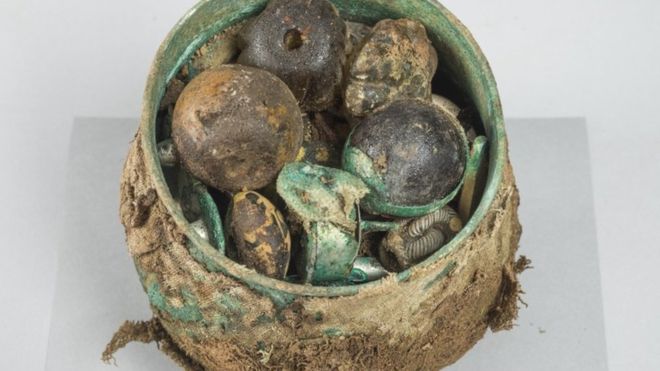
BBC reports that Historic Environment Scotland, Treasure Trove Unit, and the Queen’s and Lord Treasurer’s Remembrance’s conservation team have discovered an ancient Viking pot full of treasure, including six silver Anglo-Saxon disc brooches, a silver brooch from Ireland, Byzantine silk, a gold ingot, and gold and crystal objects wrapped in cloth bundles (read article here). The objects date from the 8th or 9th Century. The article goes on to tell us what the discover cannot tell us, at least without years of further research and theorizing. Stuart Campbell of the Treasure Trove Unit says, “”The complexity of the material in the hoard raises more questions than it answers, and like all the best archaeology, this find doesn’t give any easy answers. Questions about the motivations and cultural identity of the individuals who buried it will occupy scholars and researchers for years to come” (ibid.).

While we do not know whether the owner of this pot was a Christian or was more interested in laying up treasure in heaven, we do know that he (or she) was laying up treasure on this earth. We also know that this treasure did not continue to benefit the owner following his or her demise. The photographs released with the find also show that the objects have been worn and decayed with time.  It seems like a fitting illustration of what Jesus taught.

In the Sermon on the Mount, he wrote, “Do not store up for yourselves treasures on earth, where moth and rust destroy, and where thieves break in and steal. But store up for yourselves treasures in heaven, where neither moth nor rust destroys, and where thieves do not break in or steal; for where your treasure is, there your heart will be also” (Mat. 6:19-21).  He doesn’t condemn saving or even making money. He does continue to warn that one inevitably chooses God or money as master (Mat. 6:24). This find in Dumfries and Galloway, Scotland, reminds us of the ultimate futility in laying up treasures on the earth.  What’s held and hoarded isn’t stored in heaven, but it does reflect what’s in the heart. Later, Paul urges Timothy to teach the need to fix the hope on God rather than riches (1 Tim. 6:17).

It would be great to find out that this was the church treasury of a congregation of God’s people being taken and used to help the poor or preach the gospel or the personal portfolio of a person who put his riches to good use in the kingdom. It’s not statistically probable, but it’s possible. What I do know is that there is a Perfect, Heavenly Accountant who knows what we treasure most. May our legacy be that we “seek first the kingdom of God and His righteousness” (Mat. 6:33).

88913064_vesselwithlidremoved