WHAT WOULD I GRAB?

Monday’s Column: Neal At The Cross

pollard

Neal Pollard

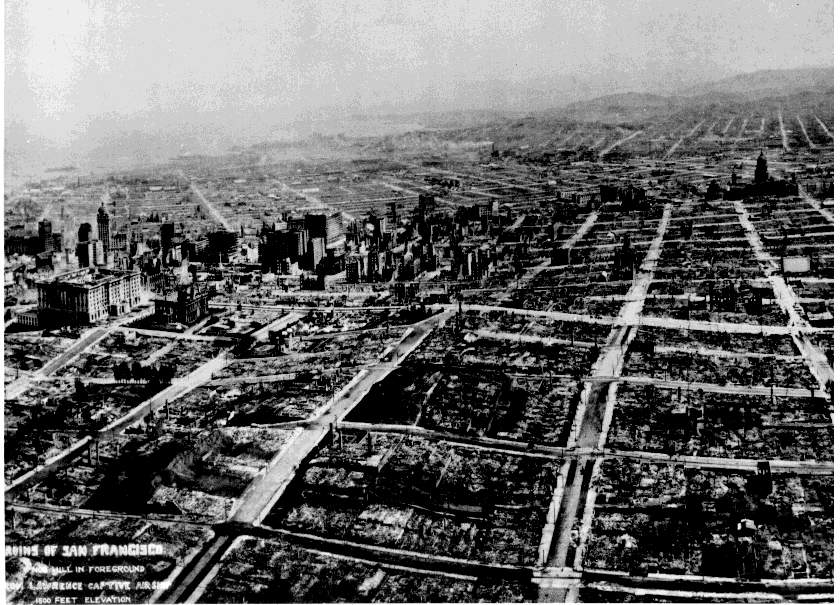
John Castillo Kennedy writes a riveting account of the fire that swept through San Francisco in the wake of the catastrophic earthquake that struck on April 18, 1906. The earthquake and resulting fires, which killed 3000 people, destroyed 80% of the city. Among the dead was the city fire chief. Firefighters, unaccustomed to using dynamite to create firebreaks, caused several of the fires. 

At one point early in the fires, according to Castillo, the spread of the flames surprised people living along Pine, Bush, and Sutter Streets, forcing them to flee immediately. They had been confident that the flames would not reach them there. The author says,

“Quickly filled trunks grated up the hills. Wagons, mostly pulled by men, rattled over the rough cobblestones. Baby carriages and toy express wagons rolled along packed full with the ‘things’ people had snatched up in the flight. Pianos were bumped along the sidewalks–some went to pieces in the process. Sewing machines slipped along on their rollers with stacks of bedding and the like lashed to them. Women had their valuables on their person, or carried trinkets Gypsywise in handkerchiefs. Men wore columns of hats five-high. Some carried only a book. Parrots jabbered and scolded from many cages. Some people had blankets. Girls usually had bandboxes. Boys stretched poles between them and carried, suspended there, bundles of clothing and provisions. Once it was only a ham” (83). 

These panic-stricken people, with no time to prepare, reached for the thing that had the most practical or sentimental value to them. Something made people faced with total loss and threat of life to lug heavy items or pets or food. Many of the choices seem irrational. Perhaps they were in shock or acting in impulse. In essays and contests asking people what they would grab if their house was on fire and they could only grab one thing, they have cited passports, wills, legal documents, insurance policies, personal papers, portable hard drives, phones, etc.

I’m trying to put myself in their shoes. If I was in one of the many neighborhoods forced to flee my home with no time to spare, what would I have been sure to grab? How long would it take my mind to settle on sentimental family items like old photos, my wedding video, or the boys’ baby books? Would I be relieved if I could make it out with my Bible, though I saved nothing else?

I do not judge those folks with their bizarre, split-second decisions. For some reason, it just made me do some introspection. What does my priority list look like? What do I value most in my life and in my home? What would I try to be sure to preserve?

Perhaps the answers to those questions is best provided by my choices in ordinary, every-day actions. I want my wife, children, fellow-Christians, and, most of all, my God to see from my life that they come before the things of this world. The things will all ultimately burn (2 Pet. 3:10). It is the relationships that will outlast the final, global conflagration. I pray that my influence and example will save them from the fire (Jude 23).  

Reference: Kennedy, John Castillo. The Great Earthquake And Fire: San Francisco, 1906 (New York: William Morrow and Co., 1963). 
 

Jane Roe/Norma McCorvey

Neal Pollard

She was used by pro-abortion and pro-life groups, but in fairness nobody outdid Norma McCorvey at trying to use others for personal advantage. Her effort to abort her third child, in Texas in 1970, was the case used to go to the Supreme Court. By the time the appeals process wound up in legalizing abortion at the federal level, her baby was almost three years old and in the home of adoptive parents. She was the product of neglect and horrible abuse, was promiscuous, bisexual—though mostly lesbian, and was known to try to make her way by hook or crook for most of her life. She tried to leverage her infamy into financial advantage or at least a living wage.

It’s wonderful to see that this tormented woman publicly changed her position regarding the right and sanctity of the unborn, but her home life and adult life symbolize the growing immorality stemming from a breakdown in the home. A father fairly well abandoned his role in the home. Alcohol and drugs complicated and clouded the decisions and thinking within the home. Sexual immorality created multiple problems. Sin was perpetuated from poor examples there (The Washington Post, Emily Langer, 2/18/17).

Pew Research found that 46% of “U.S. kids younger than 18 years of age are living in a home with two married heterosexual parents in their first marriage. This is a marked change from 1960, when 73% of children fit this description, and 1980, when 61% did” (Gretchen Livingston, 12/22/14). This is only part of the story. I know of several scripturally divorced and remarried couples, with blended families, who have raised righteous, believing children. But, the general breakdown of the home is at the heart of so many of society’s woes.

The foregoing is far from revelatory. Sermons, articles, and Bible classes have trumpeted it for years. What I see in our broken society is endless opportunity. It will require patience, time, and lots of love, but homes like the one McCorvey grew up in and the one she attempted herself are craving what only Christ can supply—fulfillment, joy, peace, and direction. That is where you and I come in. Let us remember what we’ve been told by God: “But you are a chosen race, a royal priesthood, a holy nation, a people for God’s own possession, so that you may proclaim the excellencies of Him who has called you out of darkness into His marvelous light” (1 Pet. 2:9). Let’s be shining!

2211858253_9a8fa45364_b

THE BEAUTY OF PERSONAL INTEGRITY

Neal Pollard

There is an old episode of Father Knows Best where Bud, the Andersons’ son, has a glowing write up in the local newspaper for his star performance as his High School’s placekicker.  Success goes to his head, leading Bud to break the team’s training rules and stay out past 9:00 P.M.  His father finds out and urges him to tell his coach.  Bud begrudgingly does so, and he becomes convinced that his doing the right thing and being honest would lead the coach to let him off with a warning or look the other way.  When he’s told he cannot play that week because of his violation, he sulks and even blames his dad for giving him bad advice.  Eventually, Bud takes ownership of his misdeed, has a more humble attitude toward his importance, and even appreciates the decisions of his dad and coach to help him excel as a person more than a player.

Perhaps personal ethics have eroded to the point that many find such advice and subsequent actions preposterous and wrongheaded. The lesson was that actions have consequences and that honesty should be practiced, not for reward but simply because it is right to do so.  Trustworthiness and responsibility are the fruits of integrity and uprightness.

These principles, though unstated in that old television show, are thoroughly biblical in nature.  Broadly, the Bible praises those of upright heart (Ps. 7:10; 64:10).  Psalm 15 says those who walk uprightly, work righteousness, and speaks truth in his heart (2). It is often more difficult to do the right thing than the easier thing, but the path of least resistance does not usually lead us in the right direction.  We made each of our boys read Alex Harris’ Do Hard Things: A Teenage Rebellion Against Low Expectations.  An overarching principle is that your choices should not be made based on what’s most convenient or least demanding.  Character is built when we have the courage of God’s convictions and do what is right, whatever it may seem to cost us in the short-term.  Ultimately, we will be better for it and so will the people in our lives!