“Stuff”

Wednesday’s Column: Third’s Words

garyandme521

Gary Pollard

We exist and interact with our reality. We drive cars, fly planes, take rockets to space, and use information technology. We study language arts and sciences. We have economies. We have feelings and opinions. We get incredible images from satellites that blow us away. We attempt to understand the complexities of life on this incredible rock. The more we learn, the more we are blown away.

We have stuff, so where did all this stuff come from? Something had to put it there. That something is clearly intelligent beyond our wildest imaginations. It would take an enormous amount of energy to fabricate all this stuff. Studying stars and galaxies leaves us dumbfounded at their sheer size and raw power. Naturalism is a comforting worldview because it removes the necessity for an entity powerful enough to create what we still don’t fully understand. Accepting the existence of such an entity forces us to admit that we’re powerless. That’s scary.

Anyways, stuff exists. We can’t do anything about that.

We have to assume that whoever’s responsible for reality is very advanced. When we research and develop incredible technologies, we’re just using extant material. Metals, power sources, polymers, silicones, electricity, all of this already exists. We just rearrange it into rockets or robots or ring lights. Whoever put everything here is, therefore, way ahead of us.

A handful of theories attempt to explain how everything got here. Many believe an explosion is responsible for reality, but cannot identify its origin. Some believe ancient aliens were responsible for life on earth, but cannot identify the origin of those aliens. Christians believe an intelligent being who exists without limitations of any kind was responsible. Of all the origin theories, this one is the most logical.

Unlike explosions or little gray men, our creator is deeply invested in his creation. He ensures our physical survival (Heb. 1.3). He gave humanity a way to live forever in a perfect world (1.3). Reality is one of the strongest evidences of a sentient, infinitely powerful being (Rom. 1.20). Once we face that reality, we have some choices to make. The choice we make determines our fate, and no choice is more critical.

(Free to use from Pixabay)

The Window To The Soul

Thursday’s Column: Carlnormous Comments

carl-pic

Carl Pollard

The eyes are the window to the soul…sounds like something straight out of a Shakespeare sonnet. While this is a phrase that was around even before the time of Christ, many believe that it is from Matthew 6:22-23.

This saying is often a misapplication of what Jesus said while preaching the Sermon on the Mount. To understand it better we need to understand the purpose of Matthew chapters 5-7. Jesus is speaking about righteousness. I’m fact, this section in chapter 6 is one of the five areas of righteousness that Jesus talks about by way of practical application. In verses 19-24, Jesus is talking about money. Using exegetical principles we can better understand Matthew 6:22-23.

Verses 19-21 say, “”Do not lay up for yourselves treasures on earth, where moth and rust destroy and where thieves break in and steal, but lay up for yourselves treasures in heaven, where neither moth nor rust destroys and where thieves do not break in and steal. For where your treasure is, there your heart will be also.”” Now notice verse 24, “”No one can serve two masters, for either he will hate the one and love the other, or he will be devoted to the one and despise the other. You cannot serve God and money.” If verses 19-21 is talking about money, and vs. 24 is talking about money, what is he talking about in verses 22-23?

Money! He says, “The eye is the lamp of the body. So, if your eye is healthy, your whole body will be full of light, but if your eye is bad, your whole body will be full of darkness.” Jesus is talking about our view of money. The eye is the lamp of the body. Basically the way we view money effects our way of living. If we have a healthy view of money, our priorities will be in line with Gods. If we have an unhealthy eye, and view money as more important, our whole body will be full of darkness because we have chosen money over God.

The problem with the saying “the eye is the window to the soul” is that it has often offered people permission to judge the state of a person’s soul. It gives permission to judge others solely because of what they perceived a person was looking at or thinking. Biblically, we can’t know the state of a person’s soul simply by looking at their eyes. Only God has the ability to see the intentions of the heart. As humans we don’t have the power to condemn someone, only God has this power.

That being said, it is our job to be attentive to people. Our duty to one another in the church is to look out for the souls of everyone. Our view of money can either corrupt our priorities, or help us grow the kingdom.

Distracted And Delayed By Baggage

Neal Pollard

On May 7, Bill McGee wrote in a USA Today article about the crashed Aeroflot plane that killed 41 of the passengers onboard: “Reports from people on the plane indicate the evacuation may have been slowed by passengers grabbing their bags. Videos show passengers taking their carry-on bags with them as they exited the plane,” the AFA said in a statement. “We will never know if more lives could have been saved if the bags were left behind” (online edition, “Were lives lost at the cost of carry-ons in Aeroflot plane crash that killed 41?”).  It’s outrageous and unbelievable that people would care more for their luggage than human lives, but that appears to be the case.

In Luke 12:15, Jesus taught, “Take heed and beware of covetousness, for one’s life does not consist in the abundance of the things he possesses.” The NASB translates the first part of the verse, saying, “Beware, and be on your guard against every form of greed….” Watching video footage of those passengers making an emergency exit with carry-ons in hand is a rather graphic, unmistakeable illustration of Jesus’ point. Unfortunately, we can have a harder time seeing ourselves doing the same thing in the prioritization of our lives. We may be aghast at the thought that their seemingly greedy decision came at the expense of some people behind them being able to escape the flames, but Scripture teaches the devastating effect greed can have on our own lives and the lives of those we influence.

Paul teaches that such can be a “snare,” “harmful desires,” plunging men into “ruin and destruction” that pierces them “with many griefs” (1 Tim. 6:9-10). It’s interesting that Paul’s inspired counsel is to “flee from these things” (11). We should consider that an inordinate desire and pursuit of material things may hurt not only ourselves, but the people that come along behind us. That includes our children, grandchildren, and the other people who are guided by our influence and example. They are watching what we value most and what has our greatest attention and affection. We may not be caught on camera, but God sees it with perfect, all-seeing eyes. 

Let’s be careful not to allow this world to cloud our judgment, making the things of this world more important than souls or the will of the Lord. The stakes are higher than whether we exit an airplane alive. It’s about how we leave this world and enter the next one.

Screen Shot 2019-05-09 at 7.24.14 AM

What We Know About Recently Uncovered Ancient Viking Treasure

Neal Pollard

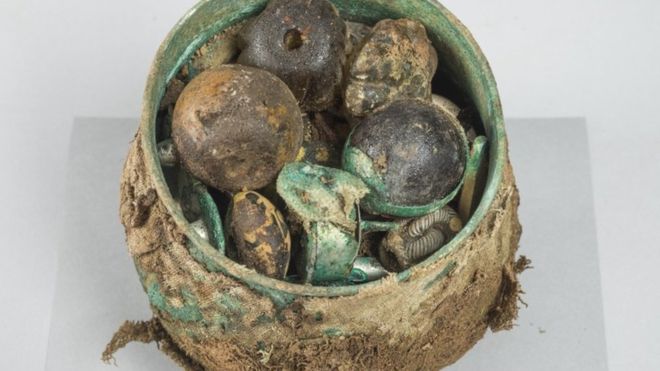
BBC reports that Historic Environment Scotland, Treasure Trove Unit, and the Queen’s and Lord Treasurer’s Remembrance’s conservation team have discovered an ancient Viking pot full of treasure, including six silver Anglo-Saxon disc brooches, a silver brooch from Ireland, Byzantine silk, a gold ingot, and gold and crystal objects wrapped in cloth bundles (read article here). The objects date from the 8th or 9th Century. The article goes on to tell us what the discover cannot tell us, at least without years of further research and theorizing. Stuart Campbell of the Treasure Trove Unit says, “”The complexity of the material in the hoard raises more questions than it answers, and like all the best archaeology, this find doesn’t give any easy answers. Questions about the motivations and cultural identity of the individuals who buried it will occupy scholars and researchers for years to come” (ibid.).

While we do not know whether the owner of this pot was a Christian or was more interested in laying up treasure in heaven, we do know that he (or she) was laying up treasure on this earth. We also know that this treasure did not continue to benefit the owner following his or her demise. The photographs released with the find also show that the objects have been worn and decayed with time.  It seems like a fitting illustration of what Jesus taught.

In the Sermon on the Mount, he wrote, “Do not store up for yourselves treasures on earth, where moth and rust destroy, and where thieves break in and steal. But store up for yourselves treasures in heaven, where neither moth nor rust destroys, and where thieves do not break in or steal; for where your treasure is, there your heart will be also” (Mat. 6:19-21).  He doesn’t condemn saving or even making money. He does continue to warn that one inevitably chooses God or money as master (Mat. 6:24). This find in Dumfries and Galloway, Scotland, reminds us of the ultimate futility in laying up treasures on the earth.  What’s held and hoarded isn’t stored in heaven, but it does reflect what’s in the heart. Later, Paul urges Timothy to teach the need to fix the hope on God rather than riches (1 Tim. 6:17).

It would be great to find out that this was the church treasury of a congregation of God’s people being taken and used to help the poor or preach the gospel or the personal portfolio of a person who put his riches to good use in the kingdom. It’s not statistically probable, but it’s possible. What I do know is that there is a Perfect, Heavenly Accountant who knows what we treasure most. May our legacy be that we “seek first the kingdom of God and His righteousness” (Mat. 6:33).

88913064_vesselwithlidremoved