The Fight Going On Inside

Clint Raymer

An old Cherokee grandfather is teaching his grandson about life: “A fight is going on inside me,” he said to the boy. ”It is a terrible fight and it is between two wolves. One is Evil. He is anger, envy, jealousy, sorrow, regret, greed, arrogance, self-pity, guilt, resentment, inferiority, lies, false pride, superiority, and ego. The other is good. He is joy, peace, love, hope, serenity, humility, kindness, benevolence, empathy, generosity, truth, compassion and faith. The same fight is going on inside you – and inside every other person, too.” The grandson thought about it for a minute and then asked his grandfather: “Which wolf wins?” The grandfather simply replied, “The one you feed.” 

This proverb reminds me of something Paul said in Romans 7:19-25. First I would like to share vs 19-23. “For the good that I will to do, I do not do; but the evil I will not to do, that I practice. Now if I do what I will not to do, it is no longer I who do it, but sin that dwells in me. I find then a law, that evil is present with me, the one who wills to do good. For I delight in the law of God according to the inward man. But I see another law in my members, warring against the law of my mind, and bringing me into captivity to the law of sin which is in my members.” Good and Evil is a battle that can be fought and seen externally in this world. However this fight is one that is both without and within. Inside each of us is a fight, a struggle, between that of the flesh and Spirit. A battle between that which is baser, and that which is better. To become more adept in both wisdom and skill when it comes to mastering this struggle requires time, effort, and self-control. There is a quote I like which says, “Self-Discipline begins with the mastery of your thoughts. If you don’t control what you think, you cannot control what you do.” 

The power and discipline of our thoughts, our mind, is paramount in controlling our actions. Henry Ford has a quote which goes, “Whether you think you can, or think you can’t, you’re right.” We must also face a hard truth in this fight to master the flesh versus the Spirit. As Paul himself said, at times we will fail. The things that we will not to do will become the things we have done, and we will fall short of the glory of God. It always seems that in these moments of failure or mistake that we are our own harshest critic. We tend to bring about our own discouragement by focusing on our shortcomings and failures again and again like a broken record until it seems hopeless to try. Yet this is not the way. 

When the walls come crashing in, nothing you do works or is good enough, and this struggle against the flesh seems hopeless. I am reminded of a simple message we all know. “For God so loved the world that He gave His only begotten Son, that whoever believes in Him should not perish but have everlasting life.” (John 3:16). While everyone is equally guilty of having succumbed to sin, fallen prey to sin, we are also equally united by one single fact. Love. God’s love, Christ’s love which was freely given so that though we were chained by sin, condemned by sin, we might be set free for a brighter future. I am often reminded of Christs words in John 15:13 “Greater love hath no man than this, that he lay down his life for his friends.” These were not just Jesus’s words, they were His actions. He freely and willingly gave His life for our sakes because He knew that in our struggle between flesh and Spirit. Sometimes we would give in to the flesh. So we would not have to suffer eternal separation from God, Christ paid the debt for those and all transgressions. All we need do to benefit from this is to submit, repent, dust ourselves off, and try again. Paul confirms this in Romans 7:24-25, “O wretched man that I am! Who will deliver me from this body of death? I thank God—through Jesus Christ our Lord! So then, with the mind I myself serve the law of God, but with the flesh the law of sin.” From this message I can draw but one conclusion. We are truly completely known and completely loved by God. 

I want to share one final thought with you, a line from one of Shakespeare’s plays, Henry the V. This line is part of what is known as the St. Crispins Day speech. It goes “We few, We happy few, We band of brothers.” This is what we are. A band of brothers and sisters in Christ, united by Christ’s love and empowered by His sacrifice to daily fight the battle of flesh versus Spirit. Firm in the knowledge that though sometimes the battle may be lost, ultimately the war is won.  

Friday’s Column: Brent’s Biblical Bytes 

From Common To Crude: “Vulgar”

81121814_2462862270639428_5746232403106463744_n

Brent Pollard

I am a word nerd. I enjoy looking into the etymology of commonly used words, such as “vulgar.” I noted that modern English translations use the word “vulgar” in 2 Samuel 6.20.  

And David returned to bless his household. But Michal the daughter of Saul came out to meet David and said, “How the king of Israel honored himself today, uncovering himself today before the eyes of his servants’ female servants, as one of the vulgar fellows shamelessly uncovers himself!” (ESV) 

How are we to interpret Michal’s words? Was David acting crudely or like a commoner? Perhaps, the Amplified Version gives us a clue. It uses the term “riffraff.” The implication, then, seems to be that David was conducting himself as a commoner rather than the king. Yet, Michal specifies that uncovering oneself was a “shameful” act. In other words, a refined person, like a king, would not behave crudely like an ordinary person.  

David did not argue with her, but it is interesting to note that she had no children following this incident, implying that she and David became estranged because of this incident (2 Samuel 6.23). (Commentators disagree about whether Michal was made barren by God or that she and David never had children together. The Septuagint and Josephus indicate that Michal did have five sons. Hence, she bore no children with David, at least from the point of this confrontation. Fortunately, salvation does not require our understanding of the truth regarding this statement.) 

“Vulgar” is a Latin word derived from “vulgus,” meaning “common people.” 1 By the 17th century, however, it had come to mean “coarse” and “ill-bred.” 2 The noun form, “vulgarity” was employed to describe “crudeness” by the 18th century. 3 So, obviously, wordsmiths associate the behavior of the masses with something or someone unseemly and lacking refinement.  A king, therefore, would not behave in that way. (To believe that, of course, you would have to ignore the histories of the many monarchies existing throughout the world’s past.)  

A synonym for “vulgar” is now “pornographic.” 4 Thus, vulgar is not a word well-esteemed in modern parlance. Yet, the Latin translation of the Scriptures is called the “Latin Vulgate.” In this instance, the term “vulgar” pertains to the language spoken by the common man. 5The type of Greek used to write the New Testament, Koine Greek, was likewise the common language spoken by the people. So, we would have to agree that God wants His Will to be easily accessible to the common man, in his common language.  

Herein lies the distinction, however. Jesus describes the rabble as making their way through life on the “highway to hell” (Matthew 7.13-14). There will be many who travel that way. The few, on the other hand, travel the difficult path leading to Heaven. You may have heard the expression, “Might makes right.” It is not that the many are evil because they are common, but that multitudes often justify committing evil deeds within their larger numbers (cf. Exodus 23.2). It is easy to get lost in a sea of faces, but God will judge us individually before His throne (Romans 14.12).  

So, it is acceptable for us to be common, but we should refrain from acting common (i.e., vulgar). From our speech to our actions, we have been called to follow a higher standard. Indeed, we are God’s special people (1 Peter 2.9). Let us then act accordingly.  


WORKS CITED 

1 Lexico Dictionaries | English. 2020. Vulgar | Definition Of Vulgar By Oxford Dictionary On Lexico.Com Also Meaning Of Vulgar. [online] Available at: <https://www.lexico.com/en/definition/vulgar> [Accessed 24 September 2020]. 

2 Harper, D., 2020. Vulgar | Origin And Meaning Of Vulgar By Online Etymology Dictionary. [online] Online Etymology Dictionary. Available at: <https://www.etymonline.com/word/vulgar>. 

3 Harper, D., 2020. Vulgarity | Origin And Meaning Of Vulgarity By Online Etymology Dictionary. [online] Online Etymology Dictionary. Available at: <https://www.etymonline.com/word/vulgarity>. 

4 Lexico Dictionaries | English. 2020. Vulgar | Definition Of Vulgar By Oxford Dictionary On Lexico.Com Also Meaning Of Vulgar. [online] Available at: <https://www.lexico.com/en/definition/vulgar> [Accessed 24 September 2020]. 

5 Lexico Dictionaries | English. 2020. Vulgate | Definition Of Vulgate By Oxford Dictionary On Lexico.Com Also Meaning Of Vulgate. [online] Available at: <https://www.lexico.com/en/definition/vulgate>  [Accessed 24 September 2020]

LET’S BE CAREFUL WITH OUR SCRUPLES!

Neal Pollard

The word “scruple” comes to us, as many words do, from a Latin word (in this case, scrupus) and it literally meant “rough pebble” and figuratively meant “anxiety.” It has come to mean “a feeling of doubt or hesitation with regard to the morality or propriety of a course of action” (Apple Dictionary, version 2.2.1, 2005-2015). All of us have scruples that reveal themselves in the standards we set for ourselves.  Often, our “doubt” or “hesitation” arises because of Bible teaching. We disapprove of sexual immorality because God forbids it. We shun drunkenness because Scripture condemns it. Where God commands something be done or avoided, we are simply exercising obedience by following His Word and even echoing His will by teaching it to others. In such cases, we are not making law but only seeking to be obedient to what God has already commanded. Yet, there are areas that fall within the realm of judgment where we must be careful to distinguish between our tastes, proclivities, and convictions and what God has actually said about it. In its more serious and sinister form, we may even draw lines of fellowship or form judgments about someone because they violate, not Scripture, but our scruples. Consider a short list of areas and examples:

  • That men must wear a suit and/or tie to the assemblies and women must wear a dress to the assemblies (most especially that the preacher must don suit and tie when he preaches).
  • Abstaining from watching all TV.
  • That putting up a Christmas tree or otherwise celebrating the season is wrong.
  • That one must offer an invitation after every sermon.
  • That there must be an evening worship assembly offered for a church to be sound.
  • Opposing tattoos of any shape, size, or place.
  • That children must be educated at home or in the public school system.
  • That allowing one’s teenaged children to date is inherently sinful.
  • That a preacher must support himself with a secular job.
  • That an organized youth program is wrong.

There is no way to be exhaustive with such a list, but what all of these (and other things) have in common is that we cannot find book, chapter, and verse that causes these scruples to rise to the level of commandment. I’m not talking about whether they are wise or unwise, what role principle might play in decision-making, or what is or is not the best judgment.  Short of a heavenly mandate, we must tread so carefully.  Most of the examples above have been the source of friction between faithful brethren who otherwise stand together upon the gospel foundation. I have strong, decided feelings on most of the matters mentioned above. A few might surprise you, but many may not. When it comes down to the brass tacks of practicality, though, we need to remember to balance Paul’s injunction to not only “bear with the scruples of the weak, and not to please ourselves” (Rom. 15:1) but also “receive one who is weak in the faith, but not to disputes over doubtful things” (Rom. 14:1). This requires such Christian qualities as wisdom, grace, patience, understanding, and love. Some battles can distract us from the real enemy. Let’s not allow that to happen!

allix_examination_of_the_scruples

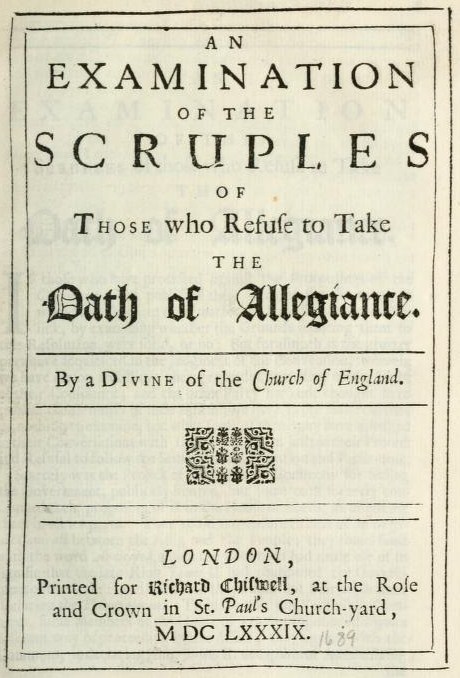
The Origin Of Scruples

Neal Pollard

Wes Autrey gave me an incredibly cool book by Charles Earle Funk.  The title of it is, “Thereby Hangs A Tale.” The book divulges the origin of words in modern usage, a study known as etymology. The fascinating explanations of many of our words is virtually endless, but the origin of our word “scruples” is particularly interesting.  Apparently, the Romans were prone to get sharp pebbles in their sandals.  They called those “pointed bits of stone” scrupulus. Funk says, “It is easy to see how the uneasiness one would feel from a pebble in the sandal gave rise to the figurative use of scrupulus for an uneasiness of the mind” (254).  In time, scrupulous has come to mean “extreme caution and carefulness.”  Scruples are “a feeling of doubt or hesitation with regard to the morality or propriety of a course of action.”

There is a connection between scruples and conscience.  It is the conscience that informs our scruples.  Our sense of right and wrong determines our caution, care, and even hesitation when we are in a given situation.  How sharp our conscience is effects how scrupulous or unscrupulous we are.

The Bible does not use the word “scruples,” but the word “conscience” is mentioned 27 times in the New Testament alone. Some people’s conscience forbids them to do what may be acceptable (cf. 1 Cor. 8:7), but others’ consciences allow them to do what is forbidden (Acts 23:1; 1 Tim. 4:2). Thus, the goal is for us to properly train and adequately sharpen the conscience.

What helps in this process is growing close to God by communing with Him in Scripture, application of Scripture, and prayer.  As we walk the narrow way, we want to feel the pain of those “pebbles” that may keep us from finishing the journey.  Is this not the idea conveyed by the writer of Hebrews, who says, “Let us also lay aside every encumbrance and the sin which so easily entangles us, and let us run with endurance the race that is set before us” (Heb. 12:1).  That rock in the shoe may be some ethical or moral practice that ultimately takes us off course.  Let us be careful to gauge the morality or propriety of any course of action, making sure it is in harmony with the goal of eternal life and not more likely to ultimately lead us away from God.