
Bible Land Tour (Mediterranean)(I)

Neal Pollard

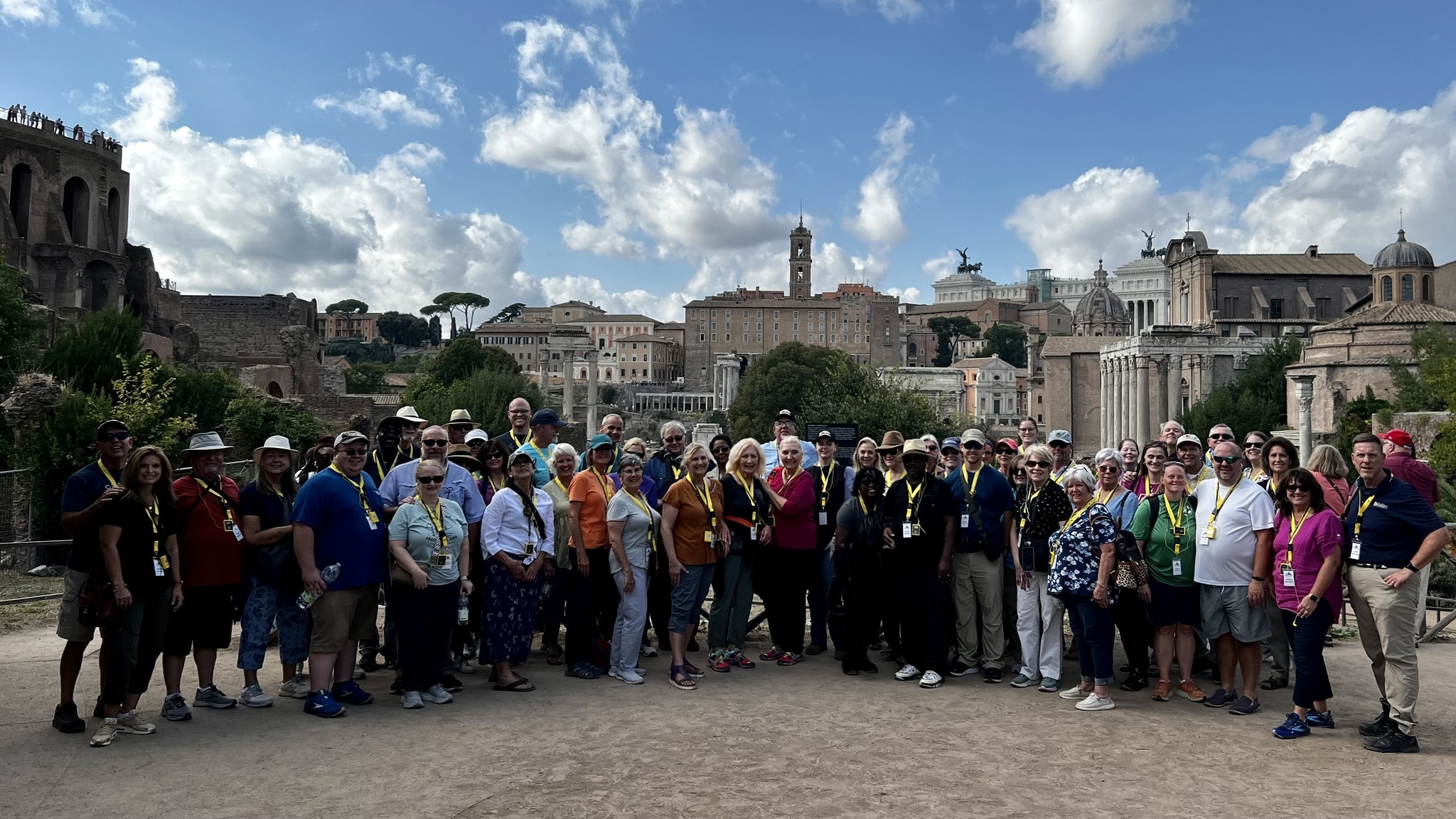
56 Christians from Arizona, Arkansas, California, Colorado, Kentucky, Michigan, Mississippi, Nebraska, South Carolina, Texas, and Virginia converged on the Hotel Gioberti in Rome, Italy, to begin a tour of places where the great preacher, evangelist, writer, and leader, Paul, shared the gospel of Christ. We began where it all ended for him: Rome. While our visit to where it all began for him, Israel, will sadly not be a part of our itinerary due to the tragic events now occurring there, we will visit a great many places where he helped fulfill Christ’s Great Commission in incredible, far-reaching ways.

He longed to get to Rome to “obtain some fruit among” them (Rom. 1:13), converting the citizens of that city the same as he had in so many other places. We know from Acts 28 that he did reach this city. This weekend, we saw what he found in his day. Emperors who would be declared gods by their senate, idolatry and the worship of gods of war, water, the sun, and a pantheon of others, and immorality like that described by Paul in Romans 1:18-32. Perhaps the first Christians came to Rome after hearing the first gospel sermon and obeying it (Acts 2:10). There are plenty of Christians to greet Paul as he approaches Rome in chains (Acts 28:14-15).

We encountered a city with stunning architecture, engineering marvels, Renaissance giants, and rich history that spans across, as John Moore eloquently put it, three eras–the pagan era, the Christian era, and the modern era. In a few hours, we will assemble with the saints at the church in Rome. It will be an exciting opportunity to meet in the capital city of what was, in the first century, the center of a global empire into which Christianity was born (Dan. 2:40-44). Standing in the midst of that city, imagining what our first-century spiritual family not only encountered but also endured, is a rare and beautiful opportunity to appreciate the power and spread of God’s eternal truth even in unfavorable social and political circumstances. It is a reminder, as Paul first put it, of the power of the gospel of Christ that brings salvation (Rom. 1:16). As Paul exhorted the Christians at Rome, I must not be ashamed of that gospel!

Socially Distant from God?

Friday’s Column: Supplemental Strength

brent 2020

Brent Pollard

Raymond Burke, an American Catholic Cardinal serving in the Vatican, voiced his opinion about the novel coronavirus. He stated that one “cannot consider the present calamity in which we find ourselves without considering how distant our popular culture is from God.” He continued, “It is not only indifferent to His presence in our midst but openly rebellious toward Him and the good order with which He has created us and sustains us in being.” 1

Burke’s comments follow his observation that in times past when plagued by disease, people normally turned to God. Under our current circumstances of trying to mitigate COVID-19, however, we are forbidden from meeting in assemblies of more than 10 persons. Burke went on to say that our homes are “a little Church into which we bring Christ from our encounter with Him in the bigger Church.” Hence, he encouraged Catholics to pray.

From a purely doctrinal standpoint, I am unable to agree with Raymond Burke. Even so, I was struck by the quotation by him which I shared. Right now, we are isolating ourselves from one another to prevent the spread of a virus. Yet, people have been keeping themselves distant from God for years. And not only do they seek to stay distant from God, but they also promote an environment that seeks to distance others from Him as well. Burke sighted those sins like abortion and the perversion of God’s design for sexuality as proof of this distancing from God. I’d be hard-pressed to disagree with that thought.

Yet, it is not just those sins that cause people to become distanced from God. For example, in Isaiah 59, Isaiah reminded those people in a covenant relationship with God under Moses’ Law that God was separated from them by their hands defiled with blood, fingers defiled by iniquity, lips speaking falsehoods, and tongues muttering wickedness (3). He further stated they conceived mischief and brought forth iniquity (4). He said their feet ran to evil (7). Consequently, they made crooked paths for themselves, which deprived others of peace when they traveled upon them (8). Frankly, modern America sounds no different.

And what was the consequence of being distant from God? Isaiah began by saying that God had become separated from them which prevented Him from hearing their prayers or helping them (1-2). Justice was far from them and despite their hope for light, they were ensconced in darkness (9). Indeed, the Israelites were blind men groping along the wall and stumbling during the day as though it were night (10). They were compared to dead men (10).  Truly, without God people are in a terrible position.

During this pandemic, I have noted more references to God on television. As I’ve heard the discussion of our mental health during this crisis, even news commentators have lauded the role of faith in preventing people from despairing. After all, hope is an anchor. Vice President Mike Pence, in commenting about the deaths from the coronavirus, quoted from 1 Thessalonians 4.13 that we do not grieve like those who have no hope. 2 As refreshing as all of this is, I am afraid that it smacks of waiting until the house has burned down to call the fire department.

If we truly want for God to bless us individually, as the church, or to bless our secular nation, we cannot afford to practice social distancing from God. We must allow for the only name given under heaven among men that saves (Acts 4.12) be always on our lips as we preach and teach to our neighbors (Matthew 28.19-20).


References

1 Chapman, Michael W. “Cardinal Burke: Consider Virus in Light of ‘Actual Sins,’ Abortion, Gender Theory.” CNSNews.com, Media Research Center, 27 Mar. 2020, 15:36, www.cnsnews.com/article/international/michael-w-chapman/cardinal-burke-consider-virus-light-actual-sins-abortion.

2 Foust, Michael. “’We Do Not Grieve Like Those Who Have No Hope,’ Pence Says of Pandemic during Easter.” ChristianHeadlines.com, Salem Web Network, 9 Apr. 2020, www.christianheadlines.com/contributors/michael-foust/we-do-not-grieve-like-those-who-have-no-hope-pence-says-of-pandemic-during-easter.html.