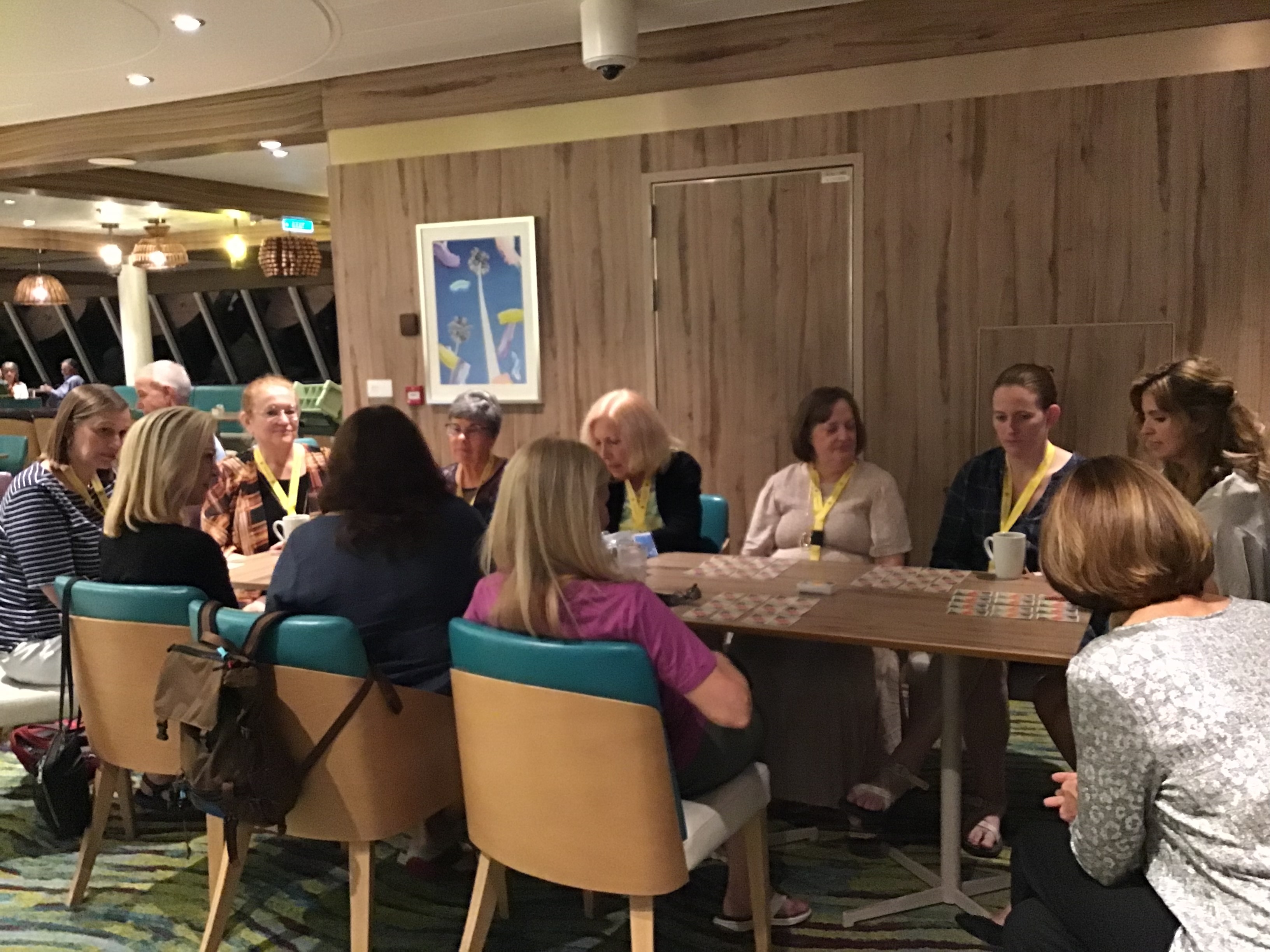
Today was the first day we did not leave the ship, but we were able to get a preview of Ephesus from John Moore as we considered one of the most important cities of the New Testament. We This day was a day about fellowship. One of the great things about a trip like this is that you get to spend quality time with brothers and sisters you go to church with or that you just met. Each night, like right now, we have the opportunity to spend time playing cards and visiting. Earlier today, there were opportunities to do bumper cars, go to the gym, or other activities with brothers and sisters in Christ. That is a serious benefit of a trip like this.
When we study the early church, we see that from the very beginning they made time to be together. The church was established in Acts 2:41, then in the very next verse we read, “They were continually devoting themselves to the apostles’ teaching and to fellowship, to the breaking of bread and to prayer” (42). They were close because they shared a common bond, had the same worldview and God-view, and they faced the same challenges of growing their faith in adverse circumstances. They shared so much together (1 Cor. 10:16). Fellowship was precious (1 Jn. 1:3,7).
Tomorrow, we embark again on a tour of a biblical site. We will have that memory in common. But, even when we return to the ship, we will continue to share! That’s just the way God set up His church!
The ship left dock yesterday evening to begin our tour through the Mediterranean. Today, we visited an iconic site that at first glance may seem to have no biblical significance. The city of Pompeii and its lesser-known neighbor, Herculanum, were destroyed by a massive volcanic explosion in 79 A.D. Herculanum, much closer to the blast, was much more destructive to its inhabitants while the city of Pompeii was almost perfectly preserved due to its being covered by ash which did not vaporize buildings and houses.
There is some theory that there were a small band of Christians in the city when the catastrophic natural disaster occurred. Beyond that, the city was thought by Jews and even Romans to be a judgment against the rampant sin and immorality of the city or a divine judgment, from the Roman historian Cassius to the Sibylline Chronicles. While we cannot know that, we know that there will be a judgment none will escape at the end that God wants us all to be prepared for.
Before we returned to the ship, we were able to see where Paul docked in Italy. The small port in Puteoli is near the modern city of Naples (Napoli). Luke records this fact for us in Acts 28:13.
It was impressive to see what the first-century world was like where Christians had to swim against the massively immoral tide of their culture and society. Spiritual darkness must have seemed eclipsing at times, but they had the boldness to live their faith even in wicked cities like Pompeii. We have so much to be thankful for as we consider the relative ease with which we can express our faith and share it today! It is not always that way. It did not seem to be in southern Italy near the end of the first-century.
Studying a map, Peter travels the road from Jerusalem northwest through Emmaus until he reaches the village of Lydda. This is the Lod of the Old Testament, part of the southern kingdom mentioned in 1 Chronicles 8:12, Ezra 2:33, and a few times in Nehemiah. The only time it occurs in the New Testament is in this paragraph. We can assume that the church was established by those present to hear Peter and the apostles preach on Pentecost. Or, perhaps, it was the efforts of those who were scattered from Jerusalem who went everywhere preaching the word (8:4). The route Peter takes to Joppa crisscrosses the road Philip took from Gaza to Caesarea Maritime (Azotus is a couple of towns south of Lydda). Whichever the case, there were already saints when Peter reaches Lydda. This includes a paralytic man named Aeneas, who Peter heals. This causes all who lived at Lydda and Sharon (Song of Sol. 2:1) to turn to the Lord (35). Faith is flourishing and the church is growing.
Peter continues his travels northwest until he reaches the seacoast city of Joppa (today, it is one of the most important cities in Israel, known today as Haifa). When Peter arrives, he’s also there to visit the church (36ff). About the time of his visit, one of the Christian women “fell sick and died” (37). We learn several things about her:
She was a disciple (36). This means she is a learner associated with Jesus’ views (BDAG 609).
She “was abounding with deeds of kindness and charity which she continually did” (36). This should not surprise us, as it seems to further define and defend the fact that she is a disciple. Jesus went “about doing good and healing all who were oppressed by the devil” (10:38). She was simply doing as He had done.
She was loved and missed by the local church (38-39). Her death was an urgent matter. They plead with Peter to come quickly. When he arrives at the upper room where she’s laid, the Christian widows are “weeping and showing all the tunics and garments that Dorcas used to make while she was with them” (39).
She was raised (40-42). Peter brings her back and presents her alive to the church. We can only imagine what joy this brought the church, but we know that this act caused many to believe in the Lord (42).
The miracles and signs performed in the early church all served the same purpose. They were to create faith in Jesus, the Man, His message, and His mission. Peter remains in Joppa many days, staying with a tanner named Simon (43). It is here that he will be a part of a dramatic turn of events that takes him north along the seacoast (Acts 10).
When Peter was invited to follow Jesus, he was told, “…I will make you fishers of men” (Mat. 4:19). Did he take any opportunities to go down to the seacoast and fish the Mediterranean while at Simon’s house? I don’t know. I do know that his primary focus now was on fishing for men. God used him mightily in that effort, both to encourage the saints and reach the lost. Likewise, whatever we were and whatever we did before becoming a disciple of Jesus, He can use us in those ways (as He did Dorcas) and leverage our experience to bring about great results to His glory!



 The Preacher Pollard Blog