
The Descendants Of Adam (5:1-32)
Neal Pollard
The men who are listed in the genealogies of Adam in this chapter have been called “the ten commitments,” trusting in God’s promise (3:15). There were spiritual giants among this group. Two of them were said to have “walked with God”–Enoch (5:24) and Noah (6:9). We probably know them most, as a group, for their longevity. In the pre-flood world, when the cursed earth was its youngest and least tainted, conditions were most ideal and genetics most favorable for long life.
James Smith gives us this chart:
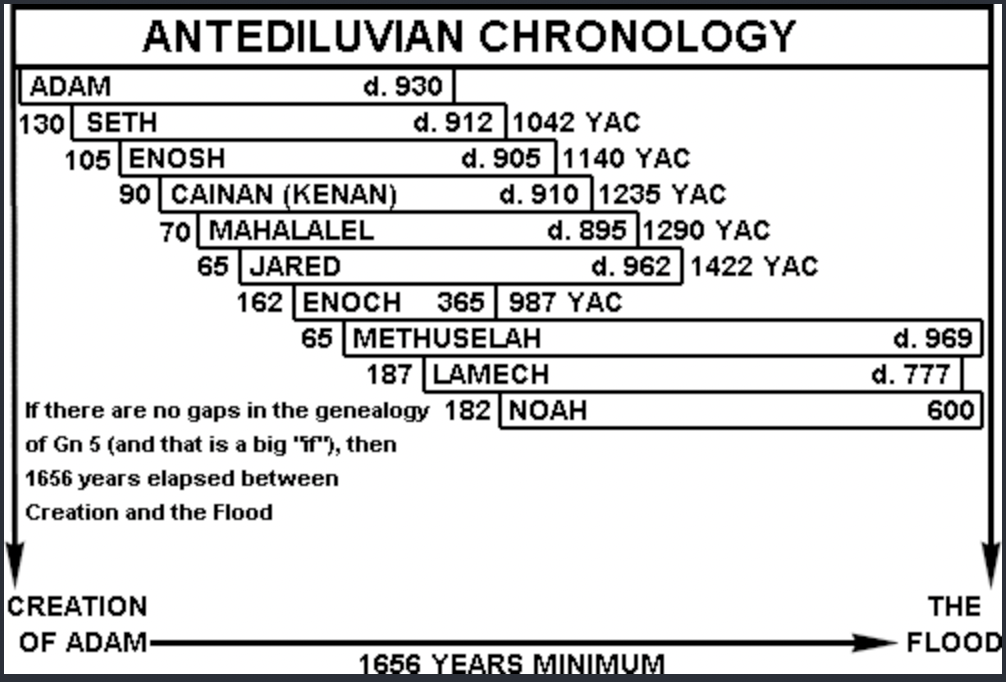
In laying out the genealogies, Moses goes back and speaks of the theology and biology of creation. Man is made in God’s likeness (1), and God made them male and female (2). Adam becomes father to a son (3), and thus it goes through all the genealogies. Moses’ record follows the same formula in laying out these ten generations: the father lives so many years, has a notable son (in the Messianic Genealogies–Luke 3:36-38), lives so many years after that birth, and finally dies. As the chart suggests, there is vast opportunity to populate the earth as they live on for centuries.
There are some interesting insights among the Bible’s first look into a family tree. Furthermore, there are implications from this chapter that resonate throughout the rest of Scripture. Notice just a few of these.
“…And he died” (5,8,11,14,17, 20,27,31; cf. 3:19). While these men lived nine or ten times longer than any of us would dare to believe we could live (imagine your life overlapping the lives of Saladin, Genghis Khan, and Thomas Aquinas; see also 6:3), they could not escape the reality of the death sentence brought on by Adam’s sin. Hebrews 9:27 avers that death is an inevitable appointment. 1 Corinthians 15:21-22 reiterates that by a man came death and that in Adam all die.
“Enoch walked with God” (21-24). He is the exception to the rule just mentioned. Moses writes a beautiful truth about this man. He strove for intimate fellowship with God. This is indicated by the phrase that “he walked with God.” This phrase might be ambiguous and unclear, if not for subsequent Scripture. This is tied to his faith (Heb. 11:5). Therefore, “he obtained this witness that before his being taken up he was pleasing to God.” He was a prophet of God sharing the word of God (Jude 14). We are told nothing about his wife or any of his other children apart from the famously old Methuselah, but if he lived anywhere close to the others he would likely have been alive the year of the flood if not taken by God.
God defines what walking with Him should look like, as He speaks to His people at the end of the Old Testament. Speaking of the faithful Levitical priests, He says, “He walked with Me in peace and uprightness, and he turned many back from iniquity” (Mal. 2:6). His lips preserved knowledge and He was a devoted messenger of God (Mal. 2:7). That harmonizes with what Scripture says about Enoch.
“(Noah) will give us rest” (29-32). Lamech “became the father of a son” (28) he named Noah. Why? “This one will give us rest from our work and from the toil of our hands arising from the ground which the Lord has cursed” (29). As it turns out, Noah will give comfort not to those before him but to those who would come after him through Shem, Ham, and Japheth (32). The same word translated “rest” is found in a different form in Genesis 6:6,7 and is translated “sorry.” Because God was sorry for making man, who had become sinful, He resolved to destroy man and beast. But Noah will find grace in the eyes of the Lord (6:8). The ground would continue to labor under the curse (Rom. 8:20-21). But spiritual rest would be possible through Noah’s obedience (1 Pet. 3:20; Heb. 11:7).
With all this time that passed as recorded in Genesis 5, God’s eternal plan was still in motion. Salvation would ultimately come, starting with these ten generations. Through His sovereignty and providence, God would ensure that “the kind intentions of His will” (Eph. 1:5,9) would be accomplished despite man’s continual faults and failings.
 The Preacher Pollard Blog