Not Our Problem

Gary Pollard

If I had a dollar for every time the world was supposed to have ended in my lifetime alone, I could probably fill my gas tank. Most recently, the eclipse was supposed to mark “the end.” In Graham Hancock’s 1995 book Fingerprints of the Gods, he puts great stock in the Mayan prophecy concerning the world’s end (supposedly Dec 23, 2012, conveniently revised to “no later than 2040” in Magicians of the Gods, 2015). Y2K was supposed to be a disaster. 

Just since I was born (1993), here are a few of the times the world was supposed to end (from Wikipedia, sorry): 

  1. David Berg claimed that the earth would end in 1993. 
  2. 05.02.1994 — Neal Chase’s claim that New York City would be struck by a nuclear bomb, followed shortly by the second coming. 
  3. 09.06, 09.29, 10.2.1994 — Harold Camping’s three consecutive failed predictions that the rapture would occur on these dates. 
  4. 10.23.1997 — The date, according to 17th century bishop James Ussher, that the world was supposed to end. 
  5. 03.31.1998 — Hon-Ming Chen claimed that God would come to earth in a flying saucer at 10:00 AM. 
  6. 08.18.1999 — World was supposed to end on this day, according to the psychic The Amazing Criswell. 
  7. 09.11.1999 — Earth was supposed to burn on this date, according to Philip Berg. 
  8. At least a dozen different public figures claimed the earth would end in the year 2000 (Jerry Falwell, Tim LaHaye, Jerry B. Jenkins, James Harmston, Ruth Montgomery, Edgar Cayce, Sun Myung Moon, Ed Dobson, Lester Sumrall, and others). 
  9. Some 22 other predictions between 2000 and 2024 claimed that the end of earth was imminent. 

Does earth have an expiration date? Of course! But it makes us (understandably) look ridiculous when we fall for the doomsday-predictors’ nonsense. To comfort the churches at Thessalonica, Paul made it clear that we can’t miss the second coming. A few things have to take place first: 

  1. Lawlessness runs the entire world (2.3)
  2. The majority of Christians all around the world abandon God (II Thess 2.3). 
  3. Religion is discarded (2.4). 

We aren’t there yet. The church is still doing great things all over the world! The world is chaotic, but nowhere near as bad as it could be. Rather than discarding religion, we’re now seeing people pursue it, fed up with hedonism and its best friend nihilism. This may change in our lifetime, it may not. 

I’m writing this in light of what’s happened over the last few days in the Middle East. Already we’re seeing people claim that “Armageddon” is coming because Iran attacked Israel. The point is this: we simply don’t know when Jesus will return. Of all people, we’re the ones who are supposed to be least concerned about it! Rather than portraying an image of gullibility, let’s showcase Jesus’s love to our fellow people. If he returns, great! If not, we have much better things to do than share, post, re-post, or otherwise buy into doomsday speculations. 

“It’s the end of the world…And I feel fine”

Brent Pollard

A “guilty pleasure” is something that one enjoys despite believing other people don’t generally value it or think it’s strange or unusual. It often implies enjoyment of something that societal standards may view as low-brow or embarrassing, but the individual finds personal enjoyment in it regardless. This pleasure could be a specific type of music, a television show, food, or any other enjoyable activity that might not be considered “sophisticated” or “appropriate” by some. 

Embarrassment or the acknowledgment that one’s enjoyment may not be socially acceptable causes the feeling of guilt. At the same time, “pleasure” indicates the personal joy or gratification one gets from it. Therefore, “guilty pleasure” does not always mean something unethical or immoral. It’s more about finding value in something that society frowns upon or labels as “low culture,” “kitsch,” “campy,” etc. 

Rather than being due to actual wrongdoing, guilt often results from a contrast with one’s usual standards or tastes or from a perception of the judgment of others. The concept of guilty pleasure is widely recognized and accepted as a regular part of human behavior. Hence, whether you realize it or not, you likely have a few guilty pleasures too.

Dystopian and disaster scenarios are some of my guilty pleasures. I’ll use the 2004 apocalyptic thriller The Day After Tomorrow as an illustration. It nicely sums up Al Gore’s and Greta Thunberg’s exaggerated climate alarmism. But even Roland Emmerich, who brought us Independence Day, couldn’t find mainstream success with his ludicrous environmental doomsday epic. A 50% audience score and a 45% Tomatometer score on Rotten Tomatoes explain why it’s one of my “guilty pleasures.”

Recently, I came across “Doomsday: 10 Ways the World Will End” on the History Channel. As I had a little time on my hands, I gave it a watch. I was not disappointed. Having Michio Kaku as a guest on the show was a highlight for me. I can’t put my finger on why I find him so intriguing. Therefore, I pause the remote and pay attention whenever I see his face. This series had everything in its ten hypotheticals, from a mega eruption at Yellowstone to the Earth being pulled out of orbit and hurtled into the sun.

I smiled wryly as I listened to an anthropologist with huge gauges in his earlobes describe how the latter scenario would result in a gradual temperature rise that would eventually engulf the planet in “hell.” I couldn’t help but notice that the only time producers used Bible-related terminology was about a place of eternal punishment “where their worm does not die, and the fire is not extinguished” (Mark 9.48 NASB). 

I wonder why I find it entertaining to watch things that I know to be implausible and ridiculous. I should swallow my pride rather than end up sounding like that Pharisee in the Temple. “God, I thank You that I am not like these academics who do not believe in You.” More than likely, I use my guilty pleasure to reassure myself that everything will be fine. 

I’m not a natural salesperson. The sales commission I make would not be enough to support me. However, I have studied materials on success in a cold sale. A sale that has no prior leads is considered “cold.” You are going up to a total stranger and trying to make a sale. You may see why an evangelist would read such a book out of curiosity. 

Imagining the worst-case scenario is one strategy for buffering the emotional impact of rejection. You might, for instance, imagine a situation in which, after you’ve formally introduced yourself to the homeowner, he goes off and punches you in the face for no apparent reason. If the person says “no” to your sales pitch, you can console yourself by thinking, “Well, at least he didn’t punch me in the face.” This method is great for calming your nerves.

When I watch a doomsday scenario movie or documentary, I immediately notice that the show’s producer has overlooked one crucial factor: the existence of God. God’s existence ensures that nature always follows its laws. Hence, Earth will not experience any disturbance in its orbit. Instead of suggesting that past eruptions in Yellowstone indicate a repeat occurrence, this evidence is more consistent with the mechanisms God used to destroy the world in a global deluge. Although mankind can make life on Earth quite unpleasant, only God has the power to wipe out all human life forever. In the meantime, He has promised that the cycle of planting and harvesting, cold and warmth, summer and winter, day and night, will never end (see Genesis 8.22).  

Perhaps you don’t enjoy watching disaster films or documentaries. I understand. But maybe this will help you see why I refer to this as one of my “guilty pleasures.” I know you will agree that God’s promises are worth holding on to. When fear overwhelms you, even if it seems irrational, remember to take solace in the words we attribute to the sons of Korah in Psalm 46.

“God is our refuge and strength,
A very ready help in trouble.
Therefore we will not fear, though the Earth shakes
And the mountains slip into the heart of the sea;
Though its waters roar and foam,
Though the mountains quake at its swelling pride.” (Psalm 46.1-4 NASB)  

Are You “Prepping”?

Monday’s Column: Neal At The Cross

Neal Pollard

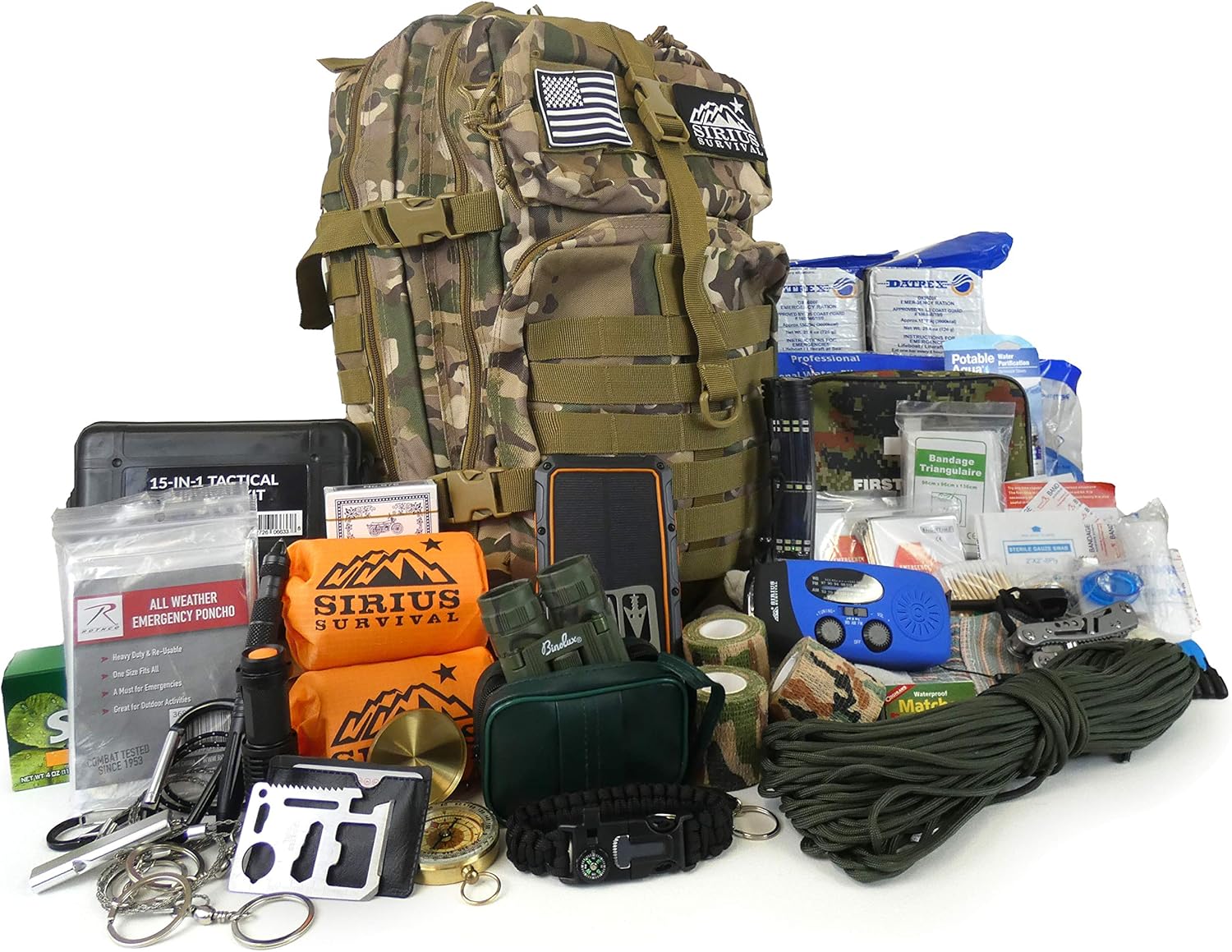
Some have called it the “doom boom.” Before Covid, Digital Media Solutions estimated that there were some 3.7 million Americans who classified themselves as “survivalists” (source). From food to water, from clothing to shelter, a growing number of people are stockpiling, hoarding, or whatever term is most relevant to their situation. Actions range from accumulating ammunition, gasoline, and can goods to building high-end luxury apocalypse shelters. Whoever the perceived enemy is, shadow governments, foreign nations, social revolutionaries, or some combination thereof, people want to be ready!  It helps them feel calm even as they have friends, neighbors, and family who seem to be doing nothing to prepare for such increasingly plausible scenarios.

Scripture does talk about the importance of preparation. True, the Bible talks about how the ant “prepares her food in the summer and gathers her provision in the harvest” (Prov. 6:8). But even greater emphasis is put on a different kind of preparation. God directs us in this readiness. 

Are you prepping for every good work (2 Tim. 2:21)? Paul tells us how that’s done in context. We must “avoid worldly and empty chatter, for it will lead to further ungodliness” (16). Paul gives as an example of this people who upset the faith of others by saying the resurrection had past. He also says to “flee from youthful lusts and pursue righteousness, faith, love, and peace” and “a pure heart” (22). Then, “refuse foolish and ignorant speculations, knowing that they produce quarrels” (23; “split hairs,” 14). An untamed tongue (Js. 3:2ff), unholy craving (1 Cor. 10:6), and undisciplined mind (Prov. 4:23) can really keep us from being prepared to do the good works God designed us to walk in (cf. Eph. 2:10)? The aim, according to Paul, is to be a vessel for honor, sanctified, useful to the Master” (21). Is what we do each day prepping us for that?

Are you prepping your mind for action (1 Pet. 1:13)? Peter writes this to a people facing persecution and spiritual adversity (6). In the first of a series of imperatives, Peter tells them to “prepare your minds for action” (literally, “gird the loins of your mind”). The word is only found in this verse, but “It is taken from the custom of the eastern nations who, when they had occasion to exert themselves (as in journeying, running, etc.), used to bind up their long–flowing garments by a girdle or belt about their hips” (Zodhiates, The complete word study dictionary, np). So, the idea is cinching up what’s loose. Peter says you prepare your mind for action by keeping sober in spirit. I find it interesting how often sober-mindedness is connected to preparing for the judgment (1 Th. 5:6,8; 2 Tim. 4:5; 1 Pet. 4:7; 5:8). Even in this passage, Peter follows this command up with the command, “fix your hope completely on the grace to be brought to you at the revelation of Jesus Christ.” There’s the action now of living the faithful Christian life, even in the face of opposition. Then, there’s the action of fixing your hope on Christ’s coming. We prepare to live in the present while preparing for the end.

Are you prepping for the Lord (Lk. 1:17)? Luke tells us that John the Baptist was sent “to make ready a people prepared for the Lord.” We can read in the New Testament that he was success in helping some do that, while so many others thought he was crazy and still others so dangerous that they resisted him. Ultimately, a wicked man who already wanted to kill him but was afraid of the many who regarded John as a prophet, found occasion to take his life (Mat. 14:5ff). His mission ultimately succeeded (Luke 7:22-23). Of course, Jesus Himself is eventually killed, but that death was necessary to help prepare us for His second coming (Heb. 9:28). There is a song which admonishes us, “There’s a great day coming…when the saint and the sinner shall be parted right and left, are you ready for that day to come?” How tragic to be stockpiling for an armageddon but unprepared for the Judgment. 

These may seem like dire days full of foreboding. Whether economic collapse, social unrest, or political corruption, we may be concerned about civil or national trouble ahead. Yet, that is not what Scripture emphasizes. Scripture emphasizes how God wants His people preparing to do good, think right, and be ready for eternity. All our “stuff” will be burned up in the end (2 Pet. 3:10). Our souls never die, and we will be somewhere eternally (Mat. 25:46). Each day is about prepping for that! May we encourage each other to get ready and stay ready!