

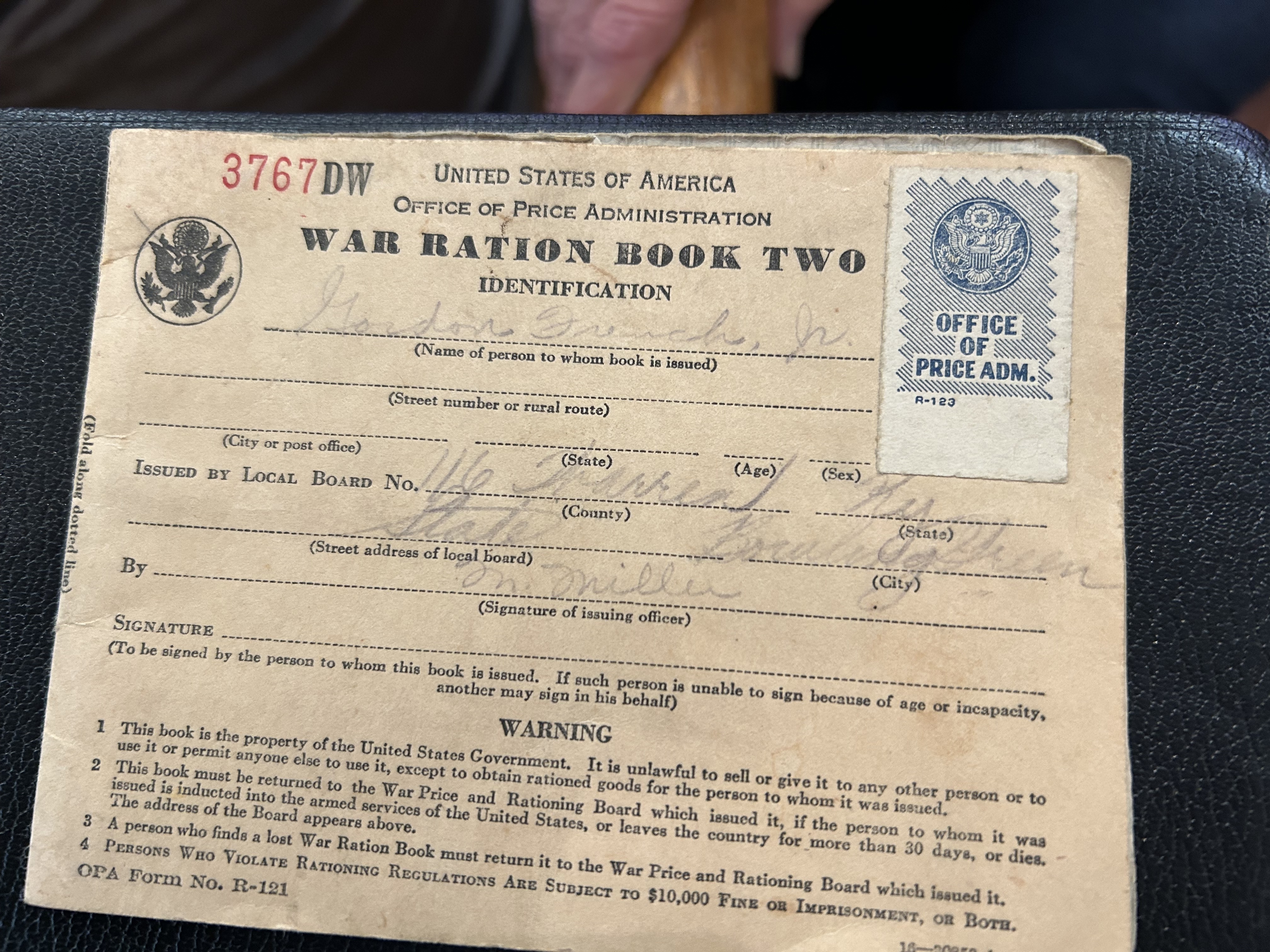
Not long ago, visiting two of our wonderful members, Dorothy and Buster French, we talked about everything from politics to family to farming and their memories growing up. Somehow, talk shifted to their memories from youth growing up during World War II. Times were difficult and Americans had to make sacrifices, doing without. This sweet couple had tangible proof of that sacrifice in a ration card they had kept from Buster’s father.
Families and households had to limit their purchase of common goods, like gasoline, butter, sugar, and canned milk (https://www.nps.gov/articles/rationing-in-wwii.htm). This allowed the government to divert needed supplies and manufacturing to goods and supplies needed to prosecute the war overseas. What I found most interesting of all was the explanation on the back of the ration book. It included the following statements:
- “This book is valuable. Do not lose it.”
- “Detailed instructions concerning the use of this book…will be issued from time to time.”
- “Do not throw this book away…”
- “You may be required to present this book…”
The last paragraph was an admonition for the bearer to do his or her part. A failure to follow the rules, they said, “helps the enemy.” The book carried the weight and authority of the Government Printing Office and was dated 1942.
It’s so hard for us, even in the volatile economics conditions of the past few years–including a disruption in the supply chain–to fathom what ordinary families endured for a half a decade or more. But the exhortations on the back of that book can be timelessly applied to the most important book of all.
Whether or not we have a favorite, well-worn copy of it, but the Bible is most valuable and its message and content cannot be lost as a lamp to our feet and light to our way (Ps. 119:105). God designed for us to have detailed instruction, “from time to time,” given concerning its use. He calls it preaching (Acts 2:42; 20:7; 1 Cor. 1:21). Figuratively speaking, morally, ethically, and doctrinally, we must never throw this book away (Ps. 50:17). Peter reminds us that we may be required to present this book to anyone who asks (1 Pet. 3:15)!
I could not help but think, God’s written word must be the most valuable resource in our lives. It supplies everlasting food and gives us access to more than consumable goods. It is to treasured above our “necessary food” (Job 23:12).
So many in the Buster and Dorothy’s generation (and their parents’) have contributed much good and the prosperity so many of us enjoy today. Things like their honest participation on the Homefront through means like rationing are example of why. We can bless our world today by being Christians who treasure the Book of books and put it to use in our lives!
 The Preacher Pollard Blog