
All Together Again (46:1-34)
Neal Pollard
The caravan noted in this chapter will make up 70 in Jacob’s household who will eventually blossom into the nation of Israel (remembering that this is the name God gave Jacob). Moses will revisit this in setting up the bondage period in Exodus 1:5, then review it at the end of his life in Deuteronomy 10:22, while Stephen in Acts 7:14 follows the Greek Old Testament (and Dead Sea scrolls) for the number 75. There are any number of ways to account for the slight disparity in numbers–like asking who was counted or omitted among the sons’ families or Joseph’s sons’ families or how many daughters besides Dinah Jacob had (37:35). The point of this chapter is to emphasize, one last time, the genealogical importance of a family central to the explanation of how the nation of Israel was formed and how the Messianic line was being formed, too. What else might we observe?
Worship was the first order of business (1-4). The evolution of Jacob’s faith was such that he was compelled to offer sacrifice when he came to the significant place of Beersheba, where his father had built an altar (26:24-25). God reveals Himself to Jacob there and reassures him that this move to Egypt was in accordance with His will. He pledges His presence to Jacob and tells him of the peaceful future that awaited him. Though some of the variables in this situation differ from what we will encounter today, may it be suggested that worship still is powerful and transforming today. God, through His Word, is still revealing Himself to us today and reassures us with His promises and helps us see that our future will be punctuated by eternal peace.
God’s foreknowledge was demonstrated and His promises fulfilled (5-27). In Genesis 15:13-14, God told Abraham that this was going to happen. Now, about 200 years later, it is occurring. Don’t miss that God tells Jacob’s grandfather, “Know for certain…” (15:13). Repeatedly, the Bible highlights that God keeps His promises (Josh. 21:43-45; 1 Ki. 8:56; 2 Cor. 1:20).
Truly, God’s promise to Abraham was now being fulfilled (8-27).It is interesting to read what undoubtedly is Egyptian confirmation of the Genesis account of Jacob’s family’s travel from Canaan to Egypt. Wilkinson writes, “A scene depicted on the tomb of Chnumhotep, the near relative and successor of Osirtasen I., at Beni-hassan, represents a company of immigrants, apparently Shemitic in their origin, entering Egypt with their goods, as well as women and children, borne upon asses. Without affirming that this was the Egyptian version of the descent of Israel into Egypt, it may serve as a striking illustration of that event” (‘Ancient Egyptians,’ vol. i. p. 480, ed. 1878; et al). Just one generation after it was only Abraham, Sarah, and Isaac, 70-plus people, enumerated in this paragraph, are filing into Goshen.
Once again, we are indebted to James Smith for his masterful charts. He gives a summary of the household of Jacob which settles in Egypt in the land of Goshen.
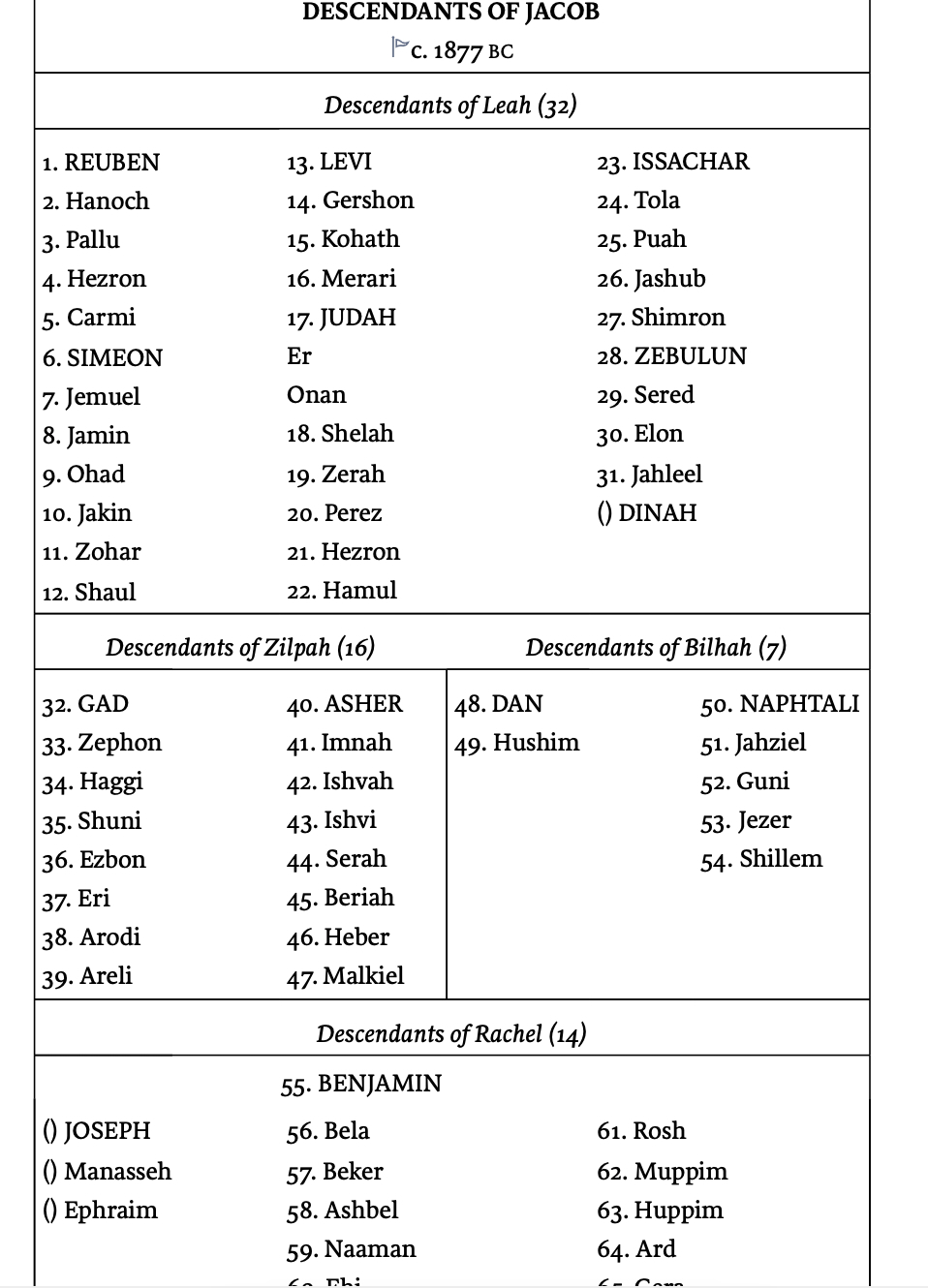
God provided a land of plenty for them to flourish in (28-34). While Canaan is called the land flowing with milk and honey and the destined possession of Jacob’s descendants, what a mark of God’s goodness to provide a place for them to burgeon into a people so numerous that Moses writes, “But the sons of Israel were fruitful and increased greatly, and multiplied, and became exceedingly mighty, so that the land was filled with them” (Ex. 1:7; cf. Ex. 1:12, 20). Goshen was that sector of Egypt where Joseph’s family is given to tend their vast herds of livestock. While we do not know exactly where Goshen is today, we do have clues. Jamie Banister says, “Clues to Goshen’s location are based on the description of the region, seemingly close to the Nile River, and the mention of Pithom and Rameses (Exod 1:11) as supply cities built by the forced labor of the Israelites who were living in Goshen. The general consensus is that Goshen was somewhere along the eastern part of the Nile Delta, probably in or near the Wadi Tumilat, a fertile valley connecting the Nile Delta east to Lake Timsah” (Barry, ed., Lexham Bib. Dict., np.).
Does it not make us think of God’s goodness, giving every good and perfect gift (Js. 1:17)? Even in time of famine, His children have all they need to fulfill God’s purpose. That does not mean that following God always brings about material prosperity; we know from the whole of Scripture that it may bring tribulation (John 16:33). Yet, we do know God is at work to fulfill His purpose through those of us who serve and follow Him (Rom. 8:28).
There is a foreshadowing of trouble to come is implied (34). There is a footnote at the end of the chapter, foreboding future events. Shepherds are loathsome to the Egyptians. That was the occupation of this family, and it would be of their descendants. At this time, the Pharaoh’s feelings of indebtedness to Joseph are recent, profound, and strong. But, later, it would not be the case (Ex. 1:8). While there would be additional reasons why later Egyptians would despise Israel (Ex. 1:10), this was an early one.

 The Preacher Pollard Blog